
Hello, everyone! It’s been a while hasn’t it? I hope you’re all as well as can be and embarking on some quality autumn reading.
Here’s a small selection of the crime that’s grabbed me lately. All three novels are loosely part of larger series, but can be read as standalones. All draw on the crime genre in intriguing ways.
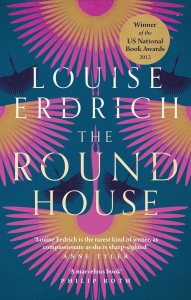
Louise Erdrich, The Round House, Corsair 2013 [2012], USA
First line: Small trees had attacked my parents’ house at the foundation.
How have I managed to miss Louise Erdrich on my literary travels? She’s such a prolific and acclaimed author, and her writing is so very good. I’ve caught up with two of her novels thus far — The Round House (2012) and The Sentence (2021). The Night Watchman (2020), which won a Pulitzer, is next on my list.
Erdrich is viewed as a ‘literary’ author rather than crime writer, but her novels often explore the impact of individual and institutional crimes. The Round House, in particular, is a stunning dissection of a crime and its spiralling consequences. Our narrator, Joe Coutts, reflects on the traumatic summer of 1988, when his mother Geraldine was raped and fell into a deep depression that threatened to destroy her.
The Coutts live on an Ojibwe reservation in North Dakota, and Joe’s father Bazil, a tribal judge, initially seeks justice for his wife via legal means. However, it’s unclear exactly where the crime against Geraldine took place — on land that’s under federal government or reservation jurisdiction? — and this slows the investigation. Frustrated, 13-year-old Joe and his friends start looking for clues, which in turn fuels a desire for revenge. The questions of what kind of justice should prevail and at what cost are thus central. So too are past and present crimes committed by the state against the Ojibwe, and especially Ojibwe women. It’s an intricate, expertly told tale, and there’s a warmth and complexity to the main characters that’s hugely compelling.
The Round House is part of Erdrich’s ‘justice trilogy’ (all three works can be read as standalones, but intersect thematically). The others are The Plague of Doves and LaRose, now also on my list.
If you’d like to learn more about this superb author, who continues to draw extensively on her Native American heritage, head over to this article on Britiannia.com.
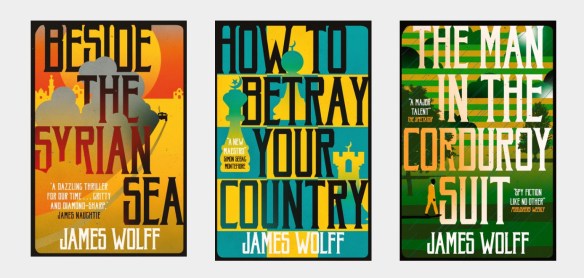
James Wolff, The Man in the Corduroy Suit, Bitter Lemon Press 2023, UK
First line: Confidential. We are writing to inform you that a 64-year-old woman named Willa KARLSSON was admitted to University College Hospital last night in an unconscious state.
One of the heirs to the late, great espionage writer John le Carré is James Wolff, who like the latter once worked for the British government in a rather opaque capacity.
Along with Mick Herron of ‘Slow Horses’ fame, Wolff shares le Carré’s deep interest in the individuals who work for the intelligence services. Some are brilliant but flawed, some are social misfits looking for a home, some are pen-pushers in search of glory, and some are collateral damage, sacrificed to strategic aims or power plays. What Herron and Wolff both excel at is capturing the Catch-22 absurdities of service life, depicting surreal, blackly comical scenarios that are more The Office than James Bond. At the same time, they raise some really serious questions about the purpose of the intelligence services and what they do — their novels are a long way from being mere comic romps.
The maverick hero of The Man in the Corduroy Suit is (wait for it) corduroy-suit-wearing Leonard Flood, a relatively junior intelligence officer who is tasked by the shadowy ‘Gatekeeping’ section to investigate the possible Russian poisoning of British agent Willa Karlsson. We follow Flood as he burrows expertly into Willa’s life and work, to the point where, like many of le Carré’s protagonists, he has big moral and ethical decisions to make.
This is the third espionage novel in the excellent ‘Discipline Files’ trilogy. I read them completely out of order, but you may wish to start with the first, Beside the Syrian Sea.

Becky Chambers, A Closed and Common Orbit (Wayfarers 2), Hodderscape 2016, USA / Space
First Line: Mimetic AI housing is banned in all GC territories, outposts, facilities and vessels.
The author Becky Chambers is another recent discovery, and quite frankly she’s a marvel. Both of her parents worked in the field of space science, and this has clearly shaped her own writing imagination…
Chambers’ ‘Wayfarers’ series, which won a prestigious Hugo Award in 2019, has been variously described as space opera, solar punk and hope punk, and explores the future of humanity via the stories of individuals and small groups living on space ships or space stations, or in GC (Galactic Commons) colonies.
While not crime fiction as such, questions of crime, justice and closure dominate A Closed and Common Orbit. The novel tells the story of AI Lovelace — recently decanted from a space ship into an illegal body following an emergency — and her engineer friend Pepper, whose own extraordinary tale of youthful survival unfolds in the course of the narrative. Those tracking current AI debates may be interested in the more hopeful possibilities the novel depicts of future human-AI interactions, as well as cross-species communications and tolerance (there are fabulous depictions of alien civilisations and cultures throughout).
A Closed and Common Orbit is the ‘standalone sequel’ to The Long Way to a Small Angry Planet. While the latter isn’t crime, it’s a great introduction to Chamber’s character-rich work. Like all of the novels discussed in this post, it has a big heart and plenty of humanity, which is certainly something we need right now.
Let me know in the comments what you’ve been enjoying too!









 Mrs. Peabody Investigates
