Jakob Arjouni’s Turkish-German Kayankaya series

I was delighted to hear that Jakob Arjouni’s Turkish-German investigator Kemal Kayankaya was going to feature on the Radio 4 ‘Foreign Bodies’ series, and to contribute a bit to the episode in question, as it gave me an excellent chance to re-read the Kayankaya novels and to get my hands on the latest instalment, Brother Kemal, published in Germany just this year.

In order of appearance, they are:

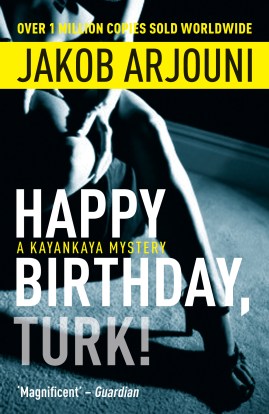
  1. Happy Birthday, Türke / Happy Birthday Turk (1985)
  2. Mehr Bier / More Beer (1987)
  3. Ein Mann, ein Mord / One Man, One Murder (1991)
  4. Kismet / Kismet (2001)
  5. Bruder Kemal / Brother Kemal (2012)

Blue Night 4 Arjouni

The first time I came across Kayankaya was in 1988, in the ‘foreign literature’ section of Borders on Oxford Street in London. The novel was Happy Birthday, Turk, which had been published in Germany in 1985, and had become a surprise critical and commercial hit. It was written by debut author Jakob Arjouni at the tender age of just nineteen.

It’s hard to overestimate how ground-breaking the figure of the Turkish-German P.I. Kemal Kayankaya was in the West Germany of the 1980s, when public attitudes towards the migrant workers who had helped to rebuild post-war Germany were deteriorating (‘job done, now please go home’). Asking German readers to identify with the likeable, wise-cracking, football-and-pickled-herring-loving Kayankaya directly challenged the dominant stereotype of ‘the Turk’ as a kebab-shop owner, rubbish collector or criminal who was poorly integrated into society and spoke only broken German. Kayankaya, the child of a Turkish migrant worker, is depicted as highly articulate, confident in his professional abilities, and – exceptionally for the time – as the holder of a West German passport, courtesy of his adoption by a German couple after his parents’ death. His characterisation thus deliberately up-ends the average German reader’s perception of what a Turkish person living in Germany ‘is like’, and confronts essentialist notions of German national identity. A Turkish-born person with a German passport? A Turkish-German citizen? Really?

Kayankaya’s early investigations, which fuse parts of the American hard-boiled tradition with the German Sozio-Krimi (sociological crime novel) of the 1970s, are used to expose the corruption of the state and to reveal the racism at the heart of West German society – the lingering legacy of National Socialism. The tables are thus deftly turned by Arjouni: the focus is on German criminal activity, and the crimes of Turks and other minorities are shown in the larger context of the unequal power-relations that exist within the state (for example, a ‘bad’ Turk is shown having been blackmailed into dealing drugs by corrupt police officers who threaten him with deportation should he not comply).

DVD cover of the film adaptation of Happy Birthday Turk (1991)

There’s also plenty of wise-cracking, acerbic humour. In fact, wit and sarcasm are shown to be key weapons when dealing with the tedious, casual racism the P.I. encounters as he goes about his daily business in Frankfurt.

Thus we are treated to the following classic exchanges:

  • German woman to Kayankaya: ‘You speak really good German!’
  • Kayankaya to German woman: ‘Thanks (long pause). You too’.

And…

  • German bureaucrat to Kayankaya: ‘Name?’
  • Kayankaya: ‘Kayankaya’.
  • German bureaucrat: ‘Spelling?’
  • Kayankaya: ‘Pretty good. Though I do have a little trouble with those foreign words’.

The Kayankaya novels are not necessarily perfect, but Kemal Kayankaya remains a ground-breaking investigative figure in the history of European crime fiction. A thoroughly original creation, he is used to raise some genuinely troubling questions about dominant social attitudes towards minorities. Many of the points the novels raise about social exclusion and about the uneven distribution of justice within society remain as pertinent today as in the 1980s.

Later novels in the series, as the ‘Foreign Bodies’ episode shows, engage with the seismic changes in Europe following the collapse of communism in 1989/90, and, most recently, with the tensions caused by Islamic fundamentalism (Brother Kemal).

You can listen to the ‘Foreign Bodies’ episode about Kemal Kayankaya, which features an interview with the author Jakob Arjouni, on BBC Radio iPlayer.

Image for PI Kemal Kayankaya

BBC Radio 4’s ‘Foreign Bodies’ episode guide…with a bit of Mrs. Peabody in #2!

Mark Lawson’s ‘Foreign Bodies’ series kicked off yesterday with an exploration of two seminal detectives from Belgium –  Hercule Poirot and Jules Maigret. Val McDermid, Andrea Camilleri, P.D. James, Jakob Arjouni and Camilla Lackberg all joined Mark for a fascinating discussion about these two key investigative figures.

Today it was the turn of Friedrich Dürrenmatt’s Swiss detective Inspector Bärlach, featuring a contribution from your very own Mrs. P… Our discussion took in Dürrenmatt’s links to earlier Swiss crime writer Friedrich Glauser, Dürrenmatt’s exploration of the moral crisis facing Europe following the Holocaust, and his subversion of the detective genre to question the possibility of justice. The crime novels discussed included The Judge and his Hangman (Der Richter und sein Henker, 1950), Suspicion (Der Verdacht, 1951) and The Pledge (Das Verprechen, 1958).

Listings for the first 7 episodes are now up on the ‘Foreign Bodies’ website. They air Monday to Friday on Radio 4 at 13.45, and are then available online. For good measure, there’s an omnibus edition on Friday at 21.00.

Episode 1  Belgium: Hercule Poirot and Jules Maigret (Agatha Christie and Georges Simenon)

Episode 2  Switzerland / Germany: Inspector Bärlach (Friedrich Dürrenmatt)

Image for Inspector Barlach

Episode 3  Czechoslovakia: Lieutenant Boruvka (Josef Skvorecky)

Episode 4  The Netherlands: Commissaris Van Der Valk (Nicolas Freeling)

Episode 5  Sweden: Inspector Martin Beck (Maj Sjöwall and Per Wahlöö)

Episode 6  UK: Commander Dalgliesh / Chief Inspector Wexford (P.D. James and Ruth Rendell)

Episode 7  Sicily: Inspector Rogas (Leonardo Sciascia)

You can also hear Bernard Hepton (who played Toby Esterhase in the BBC adaptation of Tinker Tailor Soldier Spy) begin his sublime Radio 4 reading of Dürrenmatt’s novella The Judge and his Hangman (available until 29 October).

Roseanna, the first of the Martin Beck dramatisations – will air on Radio 4 on Saturday 27 October at 14.30, but if you can’t wait, help yourself to this sneak preview.

Mrs. P’s review of Friedrich Dürrenmatt’s The Pledge is available here.

UPDATE 28 October: Mark Lawson has written an overview article about the ‘Foreign Bodies’ series for The Guardian entitled ‘Crime’s Grand Tour: European Detective Fiction’.

Ferdinand von Schirach’s The Collini Case, tr. Anthea Bell (Germany)

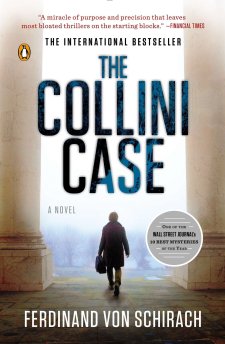
Following a lovely summer break, Mrs. P. kicks off with a review of Ferdinand von Schirach’s The Collini Case, translated from the German by Anthea Bell (London: Penguin/Michael Joseph, 2012 [2011]). It’s an effectively written courtroom drama that asks some big legal and ethical questions.

Opening line: Later, they would all of them remember it: the floor waiter, the two elderly ladies in the lift, the married couple in the fourth-floor corridor.

Ferdinand von Schirach is an eminent defence lawyer based in Berlin. He first came to prominence as a writer in 2009 with the short story collection Verbrechen (Crime), which drew heavily on the real-life cases he’d encountered during his career. It was an instant hit, spending 54 weeks at the top of the German bestseller lists, as well as critically acclaimed (the winner of the 2010 Kleist prize). A second short story collection entitled Guilt was also extremely successful, which was followed by the publication of The Collini Case, his first full-length crime novel, in 2011.

The focus on criminality, justice and the law is as evident in The Collini Case as it was in the author’s earlier works. It’s 2001 Berlin, and young barrister Caspar Leinen is assigned to defend an Italian national, Fabrizio Collini, the perpetrator in an apparently open-and-shut murder case at the famous Adlon Hotel. Only after accepting the brief does Leinen realise that he knew the victim, retired industrialist Hans Meyer: the latter was the grandfather of a close school-friend, who had been kind to Leinen in his youth. While considering whether or not he should continue to represent Collini, Leinen is faced with another problem: the accused refuses to reveal his motive for the crime. How then is Leinen to defend his client when the case comes to court? Leinen’s personal difficulties in representing Meyer’s murderer and his efforts to figure out a viable defence become the key concerns of the unfolding narrative.

Von Schirach is a skilled author who knows how to write an effective page-turner. But by far the most interesting aspect of this novel for me was the legal discussion portrayed in the courtroom section of the novel. And here I find myself in a rather difficult position, as talking about this aspect of the narrative would inevitably mean breaching Mrs. P.’s spoiler rule. So I will have to content myself by saying that the discussion of genuine points of law and their impact on a genuine set of cases since the end of the 1960s was fascinating, and is not something that I’ve seen addressed this way in a German crime novel before. 

The wider impact of the novel has also been quite extraordinary. The legal points it highlights have been raised by German MPs in the Bundestag, with a Ministry of Justice commission established in 2012 to examine the larger issues raised about legislative processes in the 1960s. It’s extremely rare for a crime novel to have such an influence in the ‘real world’, and this sets it apart from others that have tackled the same subject in a very special way.

I would second Maxine’s advice over at Petrona to read the novel before seeking out further information about the author and his work. But once you’re through, you might be interested in the following:

A Spiegel piece by von Schirach in English, in which he talks a bit about his unusual family background (thanks to Maxine for this link).

An interview with the author in German in the newspaper Die Zeit, which includes discussion about the judicial issue at the heart of the trial (contains spoilers!).

This Guardian article also draws on the interview in Die Zeit (contains spoilers!).

The comments on this post may also inadvertently hint at the novel’s content…

UPDATES

May 2013: The Collini Case has been shortlisted for the Crime Writers’ Association International Dagger Award.

And one last note: There’s extensive discussion of Bernhard Schlink’s The Reader in the comments below, which also has a courtroom section, as well as reference to Schlink’s crime novels (the ‘Selb’ series). In my capacity as an academic, I’ve written two articles on Schlink’s work, with links as follows… The first is a comparative analysis of the crime novel Selbs Justiz (which opens the ‘Selb’ series) and The Reader in the journal German Life and Letters (2006). The second looks at the controversies created in critical circles by The Reader, both in Germany and in the English-speaking world (German Monitor, 2013). It’s nearly twenty years since The Reader was published, and critical reaction to the novel and the film continues to be extremely polarised.

Creative Commons License

The Crime Writers’ Association Awards 2012

Last night, the CWA awards for 2012 were announced in London.

Two of the categories were of particular interest to me as a fan of international crime fiction. Firstly (and most obviously), the CWA International Dagger, whose shortlist included three novels from Italy, and one from Norway, Sweden and South Africa respectively. Secondly the CWA Ellis Peters Historical Dagger, whose shortlist featured the Italian crime novel I Will Have Vengeance by Maurizio de Giovanni (Hersilia Press) and Philip Kerr’s Prague Fatale (Quercus), set in Nazi Germany.

The Historical Dagger shortlist was also interesting in terms of highlighting a shift away from  ‘historical crime fiction’ set in the distant historical past (such as Ellis Peters’ famous ‘Brother Cadfael’ series) to crime fiction engaging with twentieth-century history (all but two of the shortlisted novels are set following 1930).

And the winners are…..*drumroll*

CWA International Dagger: The Potter’s Field by Andrea Camilleri               (trans. by Stephen Sartarelli and published by Mantle)

The judges said ‘Camilleri’s Montalbano novels show just how much can be achieved with familiar materials when a writer conveys the sense of life in a recognizable place. He combines characters, plots, and reflections on Italy’s particular social and political problems with wry—but never bitter—satire. In this novel the late-afternoon shadows lengthen; Montalbano is feeling his age.’

Further information about the winner and the other shortlisted novels can be found on the CWA website here.

CWA Ellis Peters Historical Dagger: Icelight by Aly Monroe                              (published by John Murray)

The judges were unanimous in their decision to award Icelight the Historical Dagger, commenting that “this tale of British post-war malaise, the third of Monroe’s Peter Cotton thrillers, is authentically downbeat yet absolutely gripping. Monroe has the young le Carré’s ability to conjure atmosphere and a poetic style worthy of Len Deighton.”

Further information about the winner and the other shortlisted novels can be found on the CWA website here.

Many congratulations to all the CWA winners and I hope everyone had a great night!

A week in Berlin: Krimis, Krimis and yet more Krimis

I was lucky enough to spend the whole of last week on a research trip in snowy Berlin, and was sure to squeeze every last drop from the marvellous opportunities this world city has to offer.

Section of the former Berlin Wall

The main reason for my trip was to see the 5500 crime novels or Krimis (Krimi = ‘Kriminalroman’) in the Kuczynsky Collection at the Berlin Central Library for my  research into East German crime fiction.

Jürgen Kuczynsky (1904-1997), a prominent GDR academic and political adviser to Honecker, was a keen crime fan, and according to the archivists had a regular cigar-for-crime-novel exchange agreement with the famous dramatist Bertolt Brecht. I was very kindly given access to this as yet uncatalogued collection, and in the course of my visit unearthed a number of extremely interesting texts, such as Gerhard Scherfling’s fascinating East German crime novel Die Zeitungsnotiz (The Newpaper Item, 1973), in which a historian is revealed as the murderer and as a former Nazi (one for my database…). I was able to peruse these on a tatty yet comfortable sofa, which was bequeathed to the library along with Kuczynski’s books, and sits in the corner of the vast storage room where the collection is currently housed. I imagine that Jürgen and Bert had some lovely chats about crime fiction while parked there.

I was also fortunate enough to be able to visit all of Berlin’s crime bookshops. Berlin is an absolute mecca for Krimi fans, as it has not one, not two, but three wonderful bookshops packed to the rafters with crime. Finding them took me all over the city, from Prenzlauer Berg in the north-east, where the Krimibuchhandlung todsicher (‘dead certain’) is located, to Charlottenburg and the Miss Marple bookshop in the west, and finally to Schöneberg and the Hammett bookshop in the south-east, near the old Tempelhof airport.

The very helpful lady in todsicher presented me with an absolute treasure trove: a whole box of GDR crime fiction from the DIE series (a witty acronym that stands for Delikte Indizien Ermittlungen / crimes, clues, investigations).

While the other two didn’t carry GDR crime (according to the owner of Hammett, the continued existence of a ‘literary wall’ means there’s little demand for works from East German publishing houses), they did have stacks of contemporary crime fiction set in Berlin, which I was also keen to see. Notably, there appears to be a mini-explosion of twentieth-century historical series by German authors at the moment, which are being strongly promoted in mainstream bookshops as well as more specialist outlets. The following caught my eye:

Volker Kutscher’s ‘Gereon Rath’ series (2007-): three novels set in 1930s Berlin (Der nasse Fisch, Der stumme Tod, Goldstein; English descriptions and sample translations available here).

Uwe Klausner’s ‘Tom Sydow’ series (2009-): four novels set in Berlin between 1942 and 1961 (Walhalla-Code, Odessa-Komplott, Bernstein-Connection, Kennedy-Syndrom).

The ‘es geschah in Berlin Kettenroman’ (the ‘it happened in Berlin chain-novel’; 2007-): currently fourteen novels set in Berlin between 1910 and 1936, featuring investigator Hermann Kappes. This series was conceived by the famous German crime writer Horst Bosetzky, but – very intriguingly – is written by a number of different authors. It’s apparently achieved cult status in Germany.

I also picked up a standalone crime novel by Mechtild Borrmann entitled Wer das Schweigen bricht (The One who Breaks the Silence, Pendragon 2011), which won the Deutscher Krimi Preis in 2012. It’s a crime novel that engages with the legacy of the National Socialism through the story of a son researching his industrialist father’s wartime past.

None of these have been translated into English as yet, although the rights to Kutscher’s novels have been snapped up in a number of other countries, including Japan.

And as if all of that wasn’t enough…I got to hang out in Berlin the same week as the Berlinale film festival and the resignation of the German President due to a corruption scandal. No visit to Berlin is ever dull. I first visited in 1988, a year before the Wall came down, and every time I go back, I continue to be amazed at the dramatic changes taking place there – best appreciated visually from the top of the space-age Fernsehturm by the Alexanderplatz.

Fernsehturm as seen from the Alex

Most striking this time round was the disappearance of the Palast der Republik (Palace of the Republic), the East German 1970s parliamentary building on Unter den Linden, which was demolished in 2008 due to its high asbestos content. The city now has ambitious plans to rebuild the Berliner Stadtschloss (Berlin City Palace), which originally stood on the site between the 1750s and 1950 … the year in which the war-damaged building was torn down by the GDR regime! Berlin is full of these sorts of mind-blowing twists and turns, with buildings, streets and even whole districts being dramatically reshaped by historical events and the rise and fall of different regimes. On discovering that one street had undergone six name changes between 1907 and 1990, I had to retreat for a calming Bier.*

All in all, it was a highly profitable and enjoyable week, and I’m already looking forward to returning to Berlin soon. Lots of reading to keep me going until then though – my return luggage contained a ridiculous number of new Krimis, which I only just managed to lug home.

*Rosa-Luxemburg-Platz: was Babelsberger Platz (1907-10), Bülowplatz (1910-33), Horst-Wessel-Platz (1933-45), Liebknechtplatz (1945-47) and Luxemburgplatz (1947-69) before taking its current name in 1969.

Would the real Finland please stand up?

Finland, Finland, Finland
The country where I want to be
Pony trekking or camping
Or just watching TV
Finland, Finland, Finland
It’s the country for me

You’re so near to Russia
So far from Japan
Quite a long way from Cairo
Lots of miles from Vietnam

Monty Python, ‘Finland Song’

My first youthful awareness of Finland came via the affectionate musical tribute by the Monty Python team. A keen ‘Fin-o-phile’ ever since, I’ve very much enjoyed reading crime novels set amongst its ‘mountains so lofty’ and ‘treetops so tall’. Along the way, via the novels of Jan Costin Wagner, I’ve developed an image of the country in line with Nordic writers such as Indridason (Iceland): freezing cold, austerly beautiful, and as melancholy as can be. This brief excerpt from Costin Wagner’s Winter of the Lions illustrates the point: ‘Then he got to his feet, walked down the dimly lit corridor and through the driving snow to his car. He drove to Lenaniemi. As the ferry made the crossing, he stood by the rail in the icy wind’ (… before visiting his wife’s grave and keeping a late-night appointment with a bottle of vodka). 

However, I’ve just had an interesting reading experience that’s challenged this romantic-melancholic view of Finland. Having finished – and very much enjoyed – Costin Wagner’s Winter of the Lions (see review here), I embarked on James Thompson’s Snow Angels (HarperCollins 2010), another police procedural, set in northern Finland (Lapland), which presents a much grittier image of a country characterised by high rates of violent crime: ‘Per capita, our murder rate is about the same as most American big cities. The over-whelming majority of our murders are intimate events. We kill the people we love, our husbands and wives, brothers and sisters, parents and friends, almost always in drunken rages’. The kaamos, the ‘darkness’ that falls over the land for long winter months, is shown to trigger high levels of depression, drinking, violence and suicide, and the way that it’s depicted here moves well beyond melancholy to something altogether darker.   

These divergent depictions of Finland ‘clashed’ for me as a reader, particularly as I read the novels more or less one after the other. Much of that sense of disjunction lay in the very different tone of the novels, which in turn reflected the contrasting literary traditions in which the authors had chosen to locate themselves. Costin Wagner (German with a Finnish wife) draws heavily on the model of Nordic crime established by writers such as Sjowall and Wahloo, Mankell, and Indridason (which reveals the underbelly of society, but has a highly controlled, pared-down style, and an introverted and melancholic feel). In contrast, Thompson (American with a Finnish wife) has channelled the grit and tone of the American thriller to create a hybrid text which his publicity blurb describes as ‘nordic noir’. It’s an often engaging, but very hard-hitting first-person narrative with frequent, extreme depictions of violence (a topic for another post another time).

The contrast between these texts and their depictions of Finland acts as a useful brake for those of us who might unquestioningly accept the portrait of any given country in a crime novel – or indeed any novel – as ‘real’ or ‘authentic’ (literature as travel guide). It’s a timely reminder of an obvious point: that authors provide representations of countries in their novels, which are often very beguiling or sell well in the literary marketplace, but which may or may not be accurate in the eyes of their citizens. And it’s not necessarily a case of ‘would the real Finland please stand up’: some Finns might identify more strongly with Costin Wagner’s portrayal of Finland than Thompson’s, or vice versa, or even think that both have validity. 

A final thought: how intriguing that neither author is Finnish by birth. Given this, one could argue that neither has a true ‘native’ insight into Finnish society, although the counter-argument that the ‘outsider’ can often see you more clearly than you see yourself could equally be applied. In the case of Costin Wagner and Thompson, it would perhaps be more accurate to speak of a complex ‘insider-outsider’ status, as foreigners who have married Finns, lived in the country for a number of years and learned the language (respect!). This dual status grants the authors a highly valuable perspective from which to write about Finland, albeit in strikingly different ways.

Creative Commons License

 
.

#18 Jan Costin Wagner / The Winter of the Lions

Jan Costin Wagner, The Winter of the Lions, translated from German by Anthea Bell (London: Harvill Secker, 2011 [2009]). The third novel in the beguiling Kimmo Joentaa series. 4 stars

 Opening sentence:  Kimmo Joentaa had been planning to spend the last hours of Christmas Eve on his own, but it didn’t turn out like that.

I was given a copy of The Winter of the Lions by my lovely brother for Christmas (following a sisterly nudge in the right direction) and it proved to be the perfect festive read, as the novel’s action begins on 24th December and ends on New Year’s Eve. The evocative cover, with its snowy Finnish birches, also made the novel an attractive winter gift.

Regular readers to this blog will know that I’m a firm fan of of the Kimmo Joentaa series, which, intriguingly, is set in Finland but is authored by a German whose wife is Finnish. The novels are suffused with nordic melancholia, and are in large measure a study of grief, as the first novel, Ice Moon, opens with the death of Detective Joentaa’s young wife. Thus, while each book contains a discrete police investigation, collectively they trace the arc of Joentaa’s grief and the slow process by which he comes to terms with his loss. The Winter of the Lions, set around three years later, sees him embarking on a fragile and rather unconventional new relationship with a women he meets through his duties as a policeman.

One of the big strengths of the series is its focus on the characters within the police team, in a way that’s reminiscent of Scandinavian writers such as Sjowall & Wahloo and Mankell. Joentaa isn’t the only team member with problems, and there are some very human depictions of individuals trying to juggle the demands of their professional lives with the stresses and strains of life beyond the office. In this novel, however, the team also has to deal with the collective trauma of one of their own being murdered. Forensic pathologist Patrik Laukkanen is found dead on a snowy cross-country ski trail in the forest, the victim of a frenzied knife attack. Soon afterwards, another man is found stabbed, and when the link between the two victims is established it proves to be a strange one: both were guests on the popular Hamalainen talk show. As the front cover tantalisingly points out, ‘careless talk costs lives’…

As in previous Joentaa novels, sections of the narrative are written from the murderer’s point of view, and we gradually build up a picture of their character and the circumstances that have led them to commit their crimes. The murderer in The Winter of the Lions is portrayed with sensitivity and a degree of sympathy, although the consequences of his/her crimes for the families of the victims are also carefully spelled out. Here, again, trauma and grief are key themes, and as in Ice Moon, there are some intriguing similarities between the murderer and the investigator whose job it is to track him/her down.

I enjoyed The Winter of the Lions almost as much as the previous two Joentaa novels (although I missed the presence of Ketola, Joentaa’s former boss), and will certainly be back for more. At the end of this third book, I realise that the value of the series lies less for me in the plot or investigative process and more in the novels’ use of the crime genre to explore human reactions to death, trauma and loss. Melancholy and beguiling, these novels are a wintry treat of the highest order.

For other Mrs P. posts on the Joentaa series see Ice Moon and Silence.

The first few chapters are available via the Random House website.

Incidentally, Silence was made into a German film in 2010 (entitled Das letzte Schweigen [the final silence]. You can see the trailer here, which looks great and makes wonderful use of the Finnish *summer* landscape (for a change). It’s in German, but don’t let that put you off!

Mrs Peabody awards The Winter of the Lions a snow and vodka fuelled 4 stars.

Creative Commons License
.

#14 Christian von Ditfurth / A Paragon of Virtue

Christian von Ditfurth, A Paragon of Virtue (Mann ohne Makel), translated from the German by Helen Atkins (London: The Toby Press 2008 [2002]). An intriguing crime novel which sees historian turn detective to help solve a murder with links to the Nazi past  4 stars

A Paragon of Virtue

Opening sentence:  The pain shot into his left knee.

Christian von Ditfurth is a German historian turned crime writer, whose debut novel, A Paragon of Virtue, was a best-seller in Germany and forms the first of the successful ‘Stachelmann series’ (currently six novels).

Part police procedural and part PI mystery, the novel divides its investigative duties between Ossi Winter, a detective with the Hamburg police, and his old friend Josef Maria Stachelmann, a historian at Hamburg University whose area of expertise is the Third Reich. It’s ultimately Stachelmann’s archival research that will prove decisive in solving the murders of a property dealer’s wife and two children, whose deaths have taken place at yearly intervals since 1999 – he’s both a detective of history, piecing together a forgotten past through archival clues, and a detective who uses those clues to solve a present-day crime. In the process, Stachelmann becomes the historical guide of a post-war Hamburg police force with scant knowledge of its Nazi past. As he educates Ossi and his colleagues about police complicity in Jewish deportations and the seizure of Jewish assets, the reader is given a sobering insight into the criminal activities of the Nazi state.

This is a highly interesting novel, set at the turn of the new millennium when a reunited Germany was (once again) examining its relation to the Nazi past. Stachelmann’s position on this issue is made very clear: we’re told he’s the author of a study entitled Forgetting and Repressing, which is critical of post-war Germany’s lack of engagement with National Socialist history. Unsurprisingly, the big theme of the novel is justice for the crimes of the past, and it’s one that’s problematised throughout the narrative: what form should post-war justice take; to what extent, if at all, has justice been done in the decades since the war; can any form of justice ever truly be considered adequate? These questions are most fully explored in the sections told from the murderer’s perspective: to a significant degree, the novel evolves into a ‘whydunit’, with the murderer’s motivation increasingly at the forefront of the narrative.

The narrative zips along at a good pace and deploys its two contrasting detective figures well. My only reservation is the characterisation of Stachelmann, who was rather irritating at times: his regular bouts of self-pity and neurotic tendencies are rather overplayed, and would have benefited from some judicious editing. On the other hand, the author’s integration of complex historical material into the crime narrative deserves praise: the information given about the operations of the Nazi state is illuminating but never feels too much like a history lesson.

I’m very interested by the fact that von Ditfurth, as a historian, has chosen to disseminate information about the Nazi era in his capacity as crime author. It would be easy to be cynical and suspect purely monetary motives (it’s still very much the case that ‘Nazis sell’), but I do think that such writers also have a genuine educative aim, and see the crime narrative as an ideal vehicle for the discussion of the criminal activities of the Nazi regime or other repressive states (Tim Rob Smith’s Child 44 also springs to mind here). The original German novel has been reprinted seventeen times, and will therefore almost certainly have had more readers than academic studies on the period, which are far less accessible (in both senses of the word) than popular fiction.

The translation into English was supported by a grant from the Goethe-Institut, which suggests that the text is seen as having historical and cultural value. The author’s website (in German) is available here. A short excerpt in English is available here.

Two other Stachelmann novels engage with the legacy of the German past, but have yet to be translated into English. They are Lüge eines Lebens (Lifelong Lie, 2008) and Labyrinth des Zorns (Labyrinth of Rage, 2009), the fourth and fifth novels in the series.

Mrs. Peabody awards A Paragon of Virtue a slightly wobbly, but very interesting 4 stars.

#9 Jan Costin Wagner / Silence

Jan Costin Wagner, Silence, translated from the German by Anthea Bell (London: Vintage 2011 [2007]). The second novel in the Kimmo Joentaa series. An absorbing police procedural and a sensitive portrayal of grief  5 stars


Opening sentence: The time came when they got into the little red car and drove away.

I wrote a short but enthusiastic post on Jan Costin Wagner’s Ice Moon back in March. While German by nationality (and writing in German), Costin Wagner is an honorary Finn by marriage, and appears to have acquired the stylistic DNA of nordic crime in the process. His police detective Kimmo Joentaa convincingly goes about his business in and around the Finnish city of Turku, and little within the narrative hints at the fact that its author was actually born and brought up in Frankfurt, nearly 1500 kilometers to the south-west.

Silence is the second in the Kimmo Joentaa series. The first, Ice Moon, depicted the harrowing weeks following the death of Kimmo’s young wife Sanna, and his desperate attempts to manage his grief by throwing himself into police-work. Silence is set a year or so later, and continues the sensitive exploration of Kimmo’s grief, as well as other kinds of grief felt by those around him, such as the parents of those who have disappeared or been murdered, or the former work colleague trying to communicate with his gravely troubled child.

When I’ve read an outstanding first novel, I’m often a bit wary of reading the second in the series, in case it doesn’t live up to the high standards of its predecessor. But Silence does a fantastic job of picking up the threads of Ice Moon, while developing the characterisation of the investigative team and providing the reader with an aborbing new crime narrative. In particular, the developing relationship between Joentaa and his recently retired and rather curmudgeonly boss, Ketola, is very nicely handled.

The novel’s investigation centres on the sudden disappearance of a teenager on her way to volleyball practice. The girl’s bicycle is found in exactly the same spot where another girl was attacked and murdered thirty-three years earlier, raising the possibility of a belated copy-cat killing. The cold case, in particular, has haunted Ketola, who was involved in the original investigation at the beginning of his career, and who now employs some rather unorthodox methods in his attempts to uncover the truth. In common with Ice Moon, the narrative also shows events from the perspective of the perpetrator, allowing readers to gain insights into the circumstances of the crime that are denied even Joentaa and Ketola. By employing this dual narrative structure, the novel succeeds in both satisfying the reader and in providing a thoughtful, nuanced, and rather disturbing conclusion to the case.

The third novel in the series, The Winter of the Lions, has just been published in translation by Vintage.

Mrs. Peabody awards Silence a classy 5 stars.

Crime novels that make you want to rant: Philip Kerr’s Field Grey (Bernie Gunther series #7)

Every now and then I read a crime novel that makes me feel grumpy, usually because of the poor quality of the writing, plotting or characterisation. Normally I don’t blog those kinds of reading experiences, and just move swiftly on to something more worthwhile. This post is going to be an exception to that rule, and concerns a once great series that has gone seriously off the rails.

A bit of a rant follows… You have been warned.

When I first discovered Philip Kerr’s ‘Berlin Noir’ trilogy in the 1990s, like many other readers I was in seventh heaven. March Violets (1989), The Pale Criminal (1990) and A German Requiem (1991) were the best crime novels I’d read in a long time, a sublime marriage of historical crime fiction and hard-boiled noir. They were also the best I’d seen set in the Nazi and Alled Occupation periods, providing a nuanced portrait of everyday life under Hitler, during the war, and in the turbulent period immediately following defeat. Collectively, they provided readers with a detailed insight into Nazi ideology and its imple-mentation, grappled with weighty themes such as guilt, justice and accountability, and examined the moral difficulties of occupying an ‘insider/outsider’ status within the regime through the figure of P.I. and sometime policeman Bernie Gunther. I’m still nostalgic for those early reading experiences (an entire holiday spent sneaking off from my beloved family to hoover up a few more chapters in delicious solitude).

After this first trilogy of Bernie Gunther novels there was considerable radio silence, and most of us assumed that the series was complete. Then, fifteen years later in 2006, another installment was published, which was swiftly followed by another three works. Each of these I purchased and read with varying degrees of pleasure, until I reached Field Grey (Quercus 2010), when a suspicion simmering at the back of my mind finally became impossible to ignore.

My suspicion was this: that Philip Kerr had intended to end the Bernie Gunther series with the third novel, A German Requiem, and that when he decided to resurrect the series fifteen years later, he made the strategic decision to take the story not just forwards but also backwards in time: forwards into the post-war era, and back to before March Violets and to other portions of the Nazi era not covered in the first three books. To put it even more bluntly: Kerr realised that he had not exploited the success of the Gunther series sufficiently, and decided to have another bite of the cherry, along the lines of George Lucas and his Star Wars prequels.

This is what we see when we compare the basic details of the first three novels with those that follow:

March Violets                     1936 Nazi Germany

The Pale Criminal              1938 Nazi Germany

A German Requiem           1947 Occupied Germany and Austria

The One from the Other   1937 Berlin / 1949 Munich

A Quiet Flame                     1950 Buenos Aires / 1932 Berlin

If the Dead Rise Not           1936 Berlin / 1954 Havana

Field Grey                             1954 Cuba, New York, Germany / 1941 Minsk /

1931 / 1940 Germany / 1940 France / 1946 Russia, Germany

So the first three novels are straightforwardly chronological (1936-1947). The remainder continue to move forward in time, but zig-zag between the post-war ‘present’ and the Weimar, Nazi or immediate post-war pasts, and between Germany, Latin America and other nations involved in World War II. In other words, books 4-7 all have structures that allow the author to dip in and out of Bernie’s previous back-story and German/ wartime history at will, and to ‘open up’ as yet unexplored and lucrative literary territory. I’m prepared to bet that if Kerr had planned a seven novel series from the start he would have written it differently, probably governed by a more conventional chronological structure. And I reckon the novels would have held together much better as a totality if he had.

One could argue that the complex temporal structure of the later books make for a more interesting read, but in the case of Field Grey, which traces Bernie’s relationship with Erich Mielke (future big cheese in the GDR Stasi) from 1931 to 1954, this approach is tested to the limit. Furthermore, the arc of their twenty-year relationship doesn’t provide a strong enough framework to sustain the novel: while there are interesting observations about post-war guilt and justice, there’s no real plot, just a series of loosely related misadventures on Gunther’s part. More seriously, the considerable amount of *new* information given about Gunther’s past has the effect of overwhelming the portrayal of the detective and his life-story from earlier works of the series. It seems particularly implausible that many of the major life events recounted in Field Grey are not referenced by Gunther in the books that have gone before. And there are some problematic disparities, such as those arising from Gunther’s differing accounts of his tranfer from Minsk in A German Requiem (Berlin Noir, Penguin: 1993, pp.592-3) and in Field Grey (pp. 89-90).

In sum, my grumpiness on finishing Field Grey appears to have had two primary causes: firstly, the unfolding of a shaggy dog story in place of a decent plot, and, secondly, the manner in which this and the other ‘later’ novels interfere with Gunther’s characterisation and the beautifully rounded entity that is the ‘Berlin Noir’ trilogy. I can’t help feeling that it would have been wiser for Kerr to have left well alone (from an aesthetic if not from a commercial point of view).

I see that there is another Bernie Gunther novel coming out in October 2011 entitled Prague Fatale. I can only hope that the title indicates what I think it does, and that Bernie is given the dignified exit he deserves.

Rant over. Thanks if you made it this far 😉

Update: Since this post, Philip Kerr has published a ninth Gunther novel entitled A Man without Breath (Quercus 2013).

I look more closely (and without ranting) at the role of Bernie Gunther in a journal article published in Comparative Literature Studies (June 2013): ‘The “Nazi Detective” as Provider of Justice in Post-1990 British and German Crime Fiction: Philip Kerr’s The Pale Criminal, Robert Harris’s Fatherland, and Richard Birkefeld and Göran Hachmeister’s Wer übrig bleibt, hat recht’.