GoetheKrimi! A report on the Goethe-Institut/New Books in German crime event

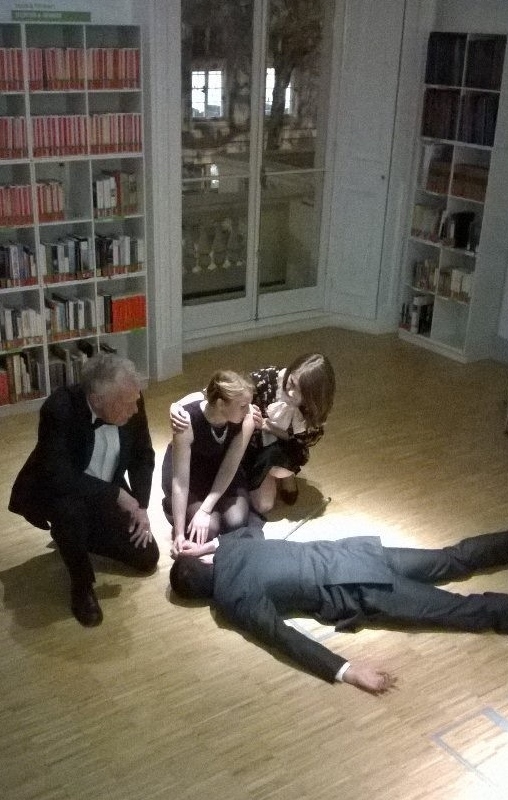
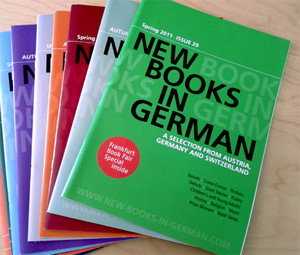
The Goethe Institut/New Books in German crime fiction evening – ‘In the Library with the Lead Piping’ – took place in London last week and was a rip-roaring success. We had an audience of around fifty, who gamely took part in our murder mystery and listened with rapt attention to authors Mechtild Borrmann, Mario Giordano, Michael Ridpath and Louise Welsh as they read from and discussed their work.

22475997513_e5f5d40f22_b

Who killed Macneath? The evening began with a murder in the library…

23071022116_8d3680d396_z

…before moving on to the readings and a discussion.

The panel discussion focused on Mechtild Borrmann’s ‘Kleve’ police procedurals and her historical novel Silence (Amazon Crossing); Michael Ridpath’s spy novel Traitor’s Gate and his Icelandic ‘Fire and Ice’ series; Mario Giordano’s screenwriting for the TV crime series Tatort (Crime Scene) and his comic crime novel Aunt Poldi and the Sicilian Lions (Bitter Lemon Press, 2016); and Louise Welsh’s psychological thrillers The Bullet Trick and The Girl on the Stairs.

As moderator, I thoroughly enjoyed putting some juicy questions to the authors about their works… 

We explored why British authors Michael and Louise chose to write novels set in Germany (Traitor’s GateThe Bullet Trick and The Girl on the Stairs); the authors’ use of settings (from urban Berlin and small-town Germany to the island of Sicily); German regional crime and the Soziokrimi or social crime novel (the ‘Kleve’ series and Tatort); the use of crime fiction to celebrate plural cultural identities (Aunt Poldi); the role of transgressive women in German film and crime (Pandora‘s Box, The Girl on the Stairs, Aunt Poldi); the challenges of writing about the Nazi past (Traitor’s Gate, Silence) and on contemporary Iceland (‘Fire and Ice’ series). We also discussed whether the former East Germany could be the next big thing in historical crime fiction or whether it was still too early to focus on this era (the authors had differing views on this point). The audience put some great questions too, asking to what extent the authors worked together with their translators, whether or not they wrote with their future readers in mind, and the nature of Ingrid Noll’s influence on contemporary German crime writing (huge).

22678870427_ce219d7386_z

Ernst the duck was the evening’s mascot – a potent reminder of the pitfalls of national stereotyping…

All in all, it was an excellent evening. Huge thanks to everyone who came along, and to Jens Boyer at the Goethe Institut London and Charlotte Ryland of New Books in German for organising such a fantastic event – Charlotte also did sterling work as a translator during the panel discussion!

We managed to interview each of the authors about their works ahead of the event – I’ll add some links to the podcasts here soon.

And here’s a good blog post by Alyson Coombes on one of Mechtild’s novels – The Other Half of Hope – which will hopefully be translated soon.

Goethe Krimi (10)

Left to right: Jens Boyer, Kat Hall, Charlotte Ryland, Louise Welsh, Mechtild Borrmann, Mario Giordano and Michael Ridpath. Photo by www.londonvideostories.com

Goethe-Insitut-50-LOGO-004      new-books-in-german

In other news, the final proofs of the Crime Fiction in German volume have just arrived from the University of Wales Press. All that remains to be done is the index, a job I enjoy as it always throws up entertaining entries. I’ll leave you to wonder how ‘Elvis Presley’, ‘Cagney and Lacey’ and ‘Dragnet‘ fit into the history of German-language crime writing!

German CF cover final

Calling the hive mind! Looking for crime novels that feature Nazi war-crimes trials

***If you have a spare minute, I’d be really grateful for your help***

I’m currently writing up a journal article on war crimes trials in Nazi-themed crime fiction. I’m interested in how crime novels since 1945 represent war crimes trials in relation to larger debates about their judicial, social and moral value, and to what extent they show legal justice as succeeding or failing.

Legal_scale-300x270

I’ve identified around 50 Nazi-themed novels that focus extensively on the theme of post-war justice, but only a much smaller number that depict or discuss war crimes trials. So the question is, can you help me find more? Here’s what I’ve got at the moment:

Crime novels (and films) containing depictions of Nazi war crimes trials:

  • William Brodrick, The Sixth Lamentation. London: Time Warner, 2004 [2003].
  • Gordon Ferris, Pilgrim Soul. London: Atlantic 2013.
  • David Thomas, Ostland. London: Quercus, 2013.
  • Joseph Kanon, The Good German. London: Time Warner, 2003 [2001].
  • Judgement at Nuremberg, dir. Stanley Kramer, 1961.
  • Music Box, dir. Constantin Costa-Gavras, 1989.
AAA ostland

This novel explores the case of Georg Heuser and his 1963 trial in West Germany

Others that feature discussion of Nazi war crimes trials include:

  • Frederick Forsyth, The Odessa File. London: Arrow, 2003 [1972].
  • Gerhard Harkenthal, Rendezvous mit dem Tod [A Date with Death]. Berlin: Buchverlag der Morgen, 1962.
  • Edgar Hilsenrath, Der Nazi & der Friseur [The Nazi and the Barber]. Munich: Piper, 2000 [1977].
  • Ira Levin. The Boys from Brazil. New York: Dell Publishing, 1976.
  • Brian Moore, The Statement. London: Flamingo, 1996 [1995].
  • Ian Rankin, The Hanging Garden. London: Orion, 1998.
  • Ferdinand von Schirach, Der Fall Collini [The Collini Case]. Munich: Piper, 2011.

Can you think of any others? They can be from anywhere in the world and don’t necessarily need to be in translation. Thanks in advance for your help 🙂

Berlinale 2015 showcases international crime dramas and thrillers from Germany, Israel, Denmark, Sweden and Italy

The 2015 Berlinale – one of the world’s top international film festivals – closes today in Berlin. As ever, a host of wonderful films have been shown during the packed ten-day programme, with the Iranian film Taxi, directed by dissident filmmaker Jafar Panahi, awarded the coveted Golden Bear.

While reading coverage of the festival, I was interested to see that some international TV dramas were premiered as part of the programme, and that a number of these had a pronounced crime/thriller/spying dimension. Alessandra Stanley’s excellent article in the New York Times provides a good overview, and also discusses how such series are beginning to be picked up in the States (and not always to be remade in English either), which is a very good sign.

Here are a few of the series in question:

Deutschland 83. There’s quite a lot of buzz about this spying drama in Germany and beyond, and it has now also been picked up by an American network (in the original German!). The central protagonist is East German border guard Martin Rauch, who is sent across the border as an undercover agent by the Stasi (the East German secret police); his task is to pose as an aid to a West German general working with NATO. Stanley describes the series as ‘an ingenious, counter-intuitive look at the Cold War’ and a recent Guardian article sees it as indicative of rising interest in the divided Germany of 1949 to 1990.

Deutschland 83

Shkufim (False Flag). According to Stanley, this Israeli political drama was inspired by the assassination of a Hamas leader in Dubai in 2010. That scenario has been reworked for the series, which shows five Israeli citizens waking up one day to find they are prime suspects in the kidnapping of a Iranian official in Moscow. The drama is produced by Tender Productions, which also has links with Homeland (which was itself based on the Israeli series Hatufim).

The five suspects in False Flag

Follow the Money is a Danish crime thriller series by DR Drama (the makers of The Killing and Borgen) due to air later this year. It focuses on corruption in big business, with a lovely twist: the business in question is a wind-power company called Energreen, with supposedly impeccable ecological and moral credentials. Insider dealings and dodgy deaths indicate that all is not as it should be.

Follow the Money. Photo credit Christian Geisnæs

1992 is an Italian drama that was picked up in Berlin by the UK, according to Stanley (though no specific channel is named). This time, the corruption of political life by big business is the focus: the drama explores the Italian bribery scandals of the 1990s, and the attempts of Milan magistrate Antonio Di Pietro to clean up politics through Operation Clean Hands (Mani Pulite).

Italian crime series 1992

Last but not least, Blå ögon (Blue Eyes) is a Swedish-German crime series that explores racism, discrimination and immigration issues. Stanley describes it as having an anti-racist message, but also wanting to ‘upend expectations’ by giving characters on all sides of the debate a voice. One of the murder victims is a female, right-wing politician, who is assassinated while out in public.

STV’s Blue Eyes

Stanley ends her piece by noting that none of these series feature the disappearance or death of a child, as seen in earlier crime series such as The Killing and Broadchurch. Or to put this another way: these dramas are moving from highly personal cases whose investigations focus on the family and small communities, to cases that address larger historical, political and social issues. Interesting times. As ever, I’m hoping that a good number will make it on to our UK and US screens.

25 years on: the fall of the Berlin Wall and the ‘deutsch-deutscher Krimi’

On a wall in my study hangs a Falk map of Berlin, on which the Berlin Wall is marked with a subtle rosy line. It’s the map I used on my year abroad in Germany, in the tumultuous year of 1989. In the space of six months I visited West and East Berlin (via Checkpoint Charlie), stayed with an East German family in Karl Marx Stadt (relatives of my German boyfriend), and then, rather disbelievingly, watched the Wall fall on TV with my great-aunt (who had seen it go up in 1961) before heading back to Berlin, this time to climb through a freshly created hole in the Wall and ponder the craziness of history while standing in the former no-man’s land.

This image of the Berlin Wall was taken in 1986 by Thierry Noir and corresponds with my memories of it in 1989

9th November 2014 marks the 25th anniversary of the remarkable day that East Germany collapsed without a single shot being fired. It’s being commemorated with a programme of events in Berlin, culminating in a Lichtgrenze (Border of Light), which sees 12 kilometers of the Wall’s former route lit with 8000 helium lights as an act of remembrance and as ‘a symbol of hope for a world without walls’. This is what it’ll look like at night:

Embedded image permalink

Lichtgrenze installation, 7-9 November (http://www.bauderfilm.de/lichtgrenze/)

Of course, one of the myriad ways in which the legacy of the East German past is still being explored is via crime fiction. Here are some examples of recent Krimis that engage with the so-called ‘deutsch-deutscher’ (German-German) question. (Unfortunately only the first one is in English translation at the moment, but hopefully the summaries below will give non-German speakers a flavour of what’s out there. And who knows, perhaps some publishers might be tempted?)

Simon Urban, Plan D (Schoeffling, 2011; Harvill Secker translation, 2013). This gutsy alternative history imagines a 2011 world in which the Berlin Wall did not fall. A blackly humorous satire, it follows the misadventures of Volkspolizei (People’s Police) investigator Martin Wegener, while giving readers an insight into life in East Germany and its historical contexts. I reviewed it favourably in 2013, and posted an East German glossary that explains some of the key events and terms in the novel.

Christa Bernuth’s Innere Sicherheit (Inner Security; Piper, 2006) is set in the East Germany of the early 1980s, before reunification seemed likely. GDR police investigator Martin Beck (a nod to Sjöwall/Wahlöö?) looks into a fatal case of Republikflucht (‘flight from the republic’) that’s not all it seems. Why has the victim been shot with a bullet used by the West? And what are her links to the West German terrorism of the 1970s? There’s an extract available (in German) on the author’s website.

Uwe Klausner, Stasi-Konzern (Stasi Business; Gmeiner, 2014). Retired police chief Tom Sydow is strolling through a West Berlin park on 9. October 1964 when shots ring out. A man has been murdered, but perpetrator and corpse quickly disappear. Sydow discovers the victim was meeting a Stasi officer and is pulled into a case that leads to the top of the East German secret police. This is the sixth installment in the historical ‘Sydow’ series. The fifth, Kennedy-Syndrom, is set in August 1961, just as the Berlin Wall goes up.

Oliver G. Wachlin, Wunderland (Wonderland; Emons, 2008). This humorous ‘Berlin-Krimi’ takes place as the Wall is falling in 1989. West German police investigator Hans Dieter Knoop views a corpse by a lake who’s wearing ice-skates … even though the water’s not yet frozen. He sets about solving this puzzle in the midst of the historical jubilation around him, and receives some unexpected visitors from the East. The second in the series, Tortenschlacht (Death by Cake), plays in 1990, shortly before German reunification.

Jay Monika Walther, Goldbroiler oder die Beschreibung einer Schlacht (Roast Chicken or the Chronicle of a Slaughter; Orange Cursor, 2009). Set shortly after the fall of the Berlin Wall in Warnemünde, this novel shows former East German citizens floundering economically in the new order. The villains are former Nazis from the west, who co-opt eastern neo-Nazis, former Stasi members and disgruntled former GDR citizens into activities such as extortion, smuggling and importing women as sex workers from eastern Europe. A bleak view of the reunited Germany.

As this small selection shows, there’s a huge amount of diversity in crime novels that engage with the East German past – in terms of the historical moment they examine (from 1961 to 1990), the perspectives they adopt (investigators from East and West), the themes they pick up (political repression, corruption, the impact on ordinary people of major social and political changes), and the style in which they are written (satirical, thriller, comic). They link to other legacies of the German past (National Socialism, left-wing terrorism) and sometimes form part of larger historical series attempting to process twentieth-century German history (Klausner’s ‘Sydow’ novels). All of them form part of a wider boom in German-language historical crime fiction, which was triggered by 1989 and the renewed interest in Germany’s ‘double past’ of fascism and communism – Eric Hobsbawm’s ‘age of extremes’ writ large. I’ve just finished a chapter on this subject for the University of Wales Crime Fiction in German volume, which has been very illuminating to write. A final point: only one of the authors above actually had lived experience of East Germany – Oliver Wachlin, who was born in the GDR in 1966. The latter is obviously not a prerequisite for writing crime about the GDR, but I find it interesting nonetheless.

The famous image of the East German Trabi busting through the Berlin Wall

Here are a few extra links to articles and websites about the former East Germany and the fall of the Berlin Wall. Coverage has been excellent:

A brilliant collection of video clips from rbb (Rundfunk Berlin-Brandenburg) that chronicle the history of the Berlin Wall and its fall. They can be viewed in German or in English.

Before and after shots of the Berlin Wall and the city from The Guardian. Click on the old image and the modern one appears – quite uncanny!

Great piece on the fall of the Berlin Wall by Timothy Garton Ash, a historian who was also an eye witness – some great images too.

An interesting piece by Philip Oltermann, on how some positive aspects of GDR society (from football to gender equality to education) are only now being properly acknowledged.

Over at Kafka’s Mouse, PD Smith has a great post on the changes to urban Berlin in the wake of reunification, with before and after images.

The British Museum currently has a major exhibition on exploring German history through a variety of objects. It’s called Germany – Memories of a Nation, and runs until January 2015. There’s a companion Radio 4 series: you can listen to an episode on the two Germanies here – the object in question is a wet-suit that was used in an escape attempt from the East in 1987.