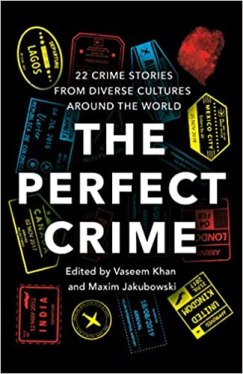
The Perfect Crime: Around the World in 22 Murders

The Perfect Crime: Around the World in 22 Murders, ed. by Vaseem Khan & Maxim Jakubowski, HarperCollins 2022

This hefty volume of crime stories is an absolute treat for all crime fans, but especially for fans of international crime. With twenty-two gripping tales that range from cosy to chilling to historical to noir, it takes us on a journey through a number of diverse cultures and satisfyingly murderous scenarios.
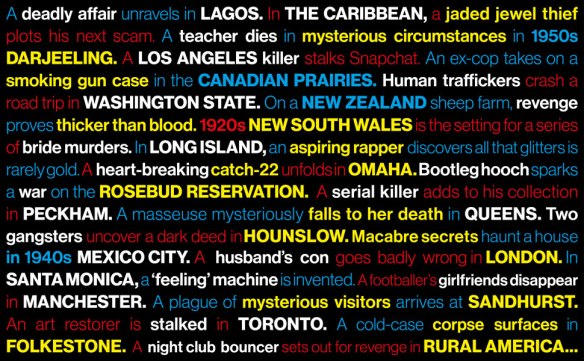
The volume is ground-breaking in one extremely important respect. As Maxim Jakubowski points out in the introduction, it gathers ‘for the very first time […] authors from a variety of cultural and ethnic backgrounds, including African-American, Asian, First Nation, Aboriginal, Latinx, Chinese-American, Singaporean and Nigerian’. And as Vaseem Khan rightly asserts: ‘The case for diversity is overwhelming […] Fiction — especially crime fiction — provides a lens onto society […and] when we underrepresent minority backgrounds, we run the risk of aiding divisiveness rather than helping to correct it’.

Khan also highlights the important role readers play in terms of ‘being willing to take a chance on books featuring diverse characters’. Well, this reader is very enthusiastically raising her hand, and I know many others will be too (not least anyone who’s enjoyed Bridgerton, which has done more to break down racial barriers via another popular genre — historical romance — than many a more earnest endeavour. Seriously, it’s genius).

And of course the volume is a great resource: in addition to featuring stories by well-known names such as Walter Mosley, Abir Mukherjee and Oyinkan Braithwaite, it gives tasters of other authors you might not yet know, but will definitely be keen to check out. The biographical notes at the back provide very helpful overviews of the authors’ profiles and works – such as David Heska Wanbli Weiden’s debut novel Winter Counts, which had a wonderful reception last year and is now firmly on my TBR list. Riches indeed!

The authors showcased are: Oyinkan Braithwaite, Abir Mukherjee, S.A. Cosby, Silvia Moreno-Garcia, J.P. Pomare, Sheena Kamal, Vaseem Khan, Sulari Gentill, Nelson George, Rachel Howzell Hall, John Vercher, Sanjida Kay, Amer Anwar, Henry Chang, Nadine Matheson, Mike Phillips, Ausma Zehanat Khan, Felicia Yap, Thomas King, Imran Mahmood, David Heska Wanbli Weiden and Walter Mosley.

Many thanks to Vaseem Khan and HarperCollins for sending me a review copy of the very handsome hardback (which incidentally would make a really fabulous gift…)

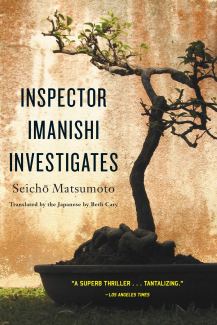
The dutiful policeman: Seicho Matsumoto’s Inspector Imanishi Investigates, tr. Beth Cary (Japan)

Seicho Matsumoto, Inspector Imanishi Investigates, tr. from the Japanese by Beth Cary, Soho Press, 2003 [1961].

Opening: The first train on the Keihin-Tohoku Line was scheduled to leave Kamata Station at 4:08 A.M.

First published in 1961, Inspector Imanishi Investigates is often viewed as a police procedural. But although it begins with a police investigation into the murder of a man found beneath a train, it soon turns into the story of Inspector Imanishi’s own quest to solve the case (as the title helpfully suggests). When the investigation is wound down due to lack of evidence, Inspector Imanishi simply refuses to give up: he painstakingly gathers clues until the full picture of the victim’s story, and that of his murderer, emerges.

One big difference between Japanese and Western police cultures becomes apparent in the process. Imanishi’s solo sleuthing isn’t viewed as a flouting of orders by his superiors, but rather as a laudable attempt to honour the victim and do a good job as a policeman, even if that means using his own time and resources. And when he uncovers vital clues, he reports back to his superiors as a matter of course, and the two continue working harmoniously together. The Western maverick police detective (think Serpico or Sarah Lund), in conflict with his/her superiors and the system, is conspicuously absent.

The pace of the investigation is leisurely with a number of dead ends. Like other police procedurals of the time, such as Sjöwall and Wahlöö’s ‘Beck’ series (1965-75), the novel conveys the often tortuously slow progress of police work, and the grit and determination required to solve a case. Some readers might find the pace a little slow, but there’s plenty to sustain interest: clues that involve regional dialects, theories of linguistic migration, bus timetables and postcards, as well as one of the most inventive murder weapons that’s ever appeared in a crime novel.

Along the way, there’s also intriguing detail about everyday Japanese life, customs, culture and food (circa 1961, at least). The conversations between individuals are always impeccably courteous, measured and polite – even between the police and the criminals they’re arresting.

The only aspect of the novel that grated was the uniformly subservient characterisation of women. I’d be interested to know if this portrayal stemmed from the author’s own attitudes or was simply a reflection of women’s social status and role in Japanese society at the time. If the latter, then I sincerely hope things have moved along in the sixty years since then.

Two other little tidbits: in 1974, the novel was turned into a film, Suna no Utsuwa, directed by Yoshitaro Nomura, which is regarded as a masterpiece of Japanese cinema. The novel’s original title was also Suna no Utsuwa, meaning Castle of Sand.

Confidence tricksters: Inventing Anna & The Shrink Next Door (USA)

Inventing Anna (Netflix 2022)

Inventing Anna has been a chart-topper on Netflix and eventually managed to lure me with its siren song. I’m glad it did: while possibly a little uneven, it’s a lively and thoughtful look at the real-life case of Anna Delvey – supposedly a super-rich German heiress, but actually a confidence trickster who managed to worm her way into the heart of New York high society.

The series is based on a 2018 New York Magazine article by Jessica Pressler called Maybe She Had So Much Money She Just Lost Track of It”, which charted the rise and fall of Anna (Delvey) Sorokin. The TV adaptation is stylishly done, with a tongue-in-cheek reminder at the beginning of every episode that “This story is completely true. Except for all the parts that aren’t”. The disclaimer cleverly references not only Anna’s wobbly relationship with the truth, but the fact that the series is a representation of often murky events.

Strengths and weaknesses: like other reviewers, I’ve wondered whether a whole nine episodes were needed and found a couple of them rather uneven. But there’s some great acting, and I like the way the series poses questions about Anna’s behaviour – not to excuse it, because hers were not victimless crimes – but to acknowledge her undoubted talents and to ask whether things might have been different had she been wealthy and/or male.

Inventing Anna reminded me of a great podcast I listened to a little while back – The Shrink Next Door – which focuses on a truly staggering case that also unfolded in New York, this time over a period of thirty years.

The podcast came about after journalist Joe Nocera made a startling discovery. His neighbour in the Hamptons, a therapist called Ike Herschkopf, was a larger-than-life figure who liked to throw star-studded parties. But one day Joe found out that Ike had abruptly left, that he actually never owned the house, and that its real owner was Marty Markowitz – the man Joe had assumed was Ike’s gardener. It turns out that Ike was Marty’s therapist, and had taken over much of his life in the course of their twenty-nine year relationship, embezzling Marty’s money and estranging him from his family along the way.

In six episodes, the podcast traces this remarkable story with the help of the very engaging Marty, his sister Phyllis, and other patients of Ike’s who had similar, often heart-breaking experiences. It’s both fascinating and enough to put you off therapy for life.

The podcast has now been turned into an Apple TV series starring Will Ferrell as Marty and Paul Rudd as Ike. It seems to have had mixed reviews, but I’ll definitely take a look if I get the chance.

Anna and Ike, two New York confidence tricksters exploiting their wealthy, high-society victims, seemingly oblivious to the impact of the crimes they’ve committed… Choose your friends wisely, folks.

Mrs. Peabody is away next week – happy reading and stay safe.

Courage & resilience: Naomi Hirahara’s Clark and Division (USA/Japan)

Naomi Hirahara, Clark and Division, Soho Crime 2021

First line: Rose was always there, even when I was being born.

I’ve had my eye on this crime novel for a while, because it uses the mystery genre to explore an under-represented part of American history: the internment of over 100,000 Japanese Americans after the 1941 bombing of Pearl Harbour, and the long-lasting impact this had on their communities and lives.

The novel is narrated by Aki Ito, born in the States to Japanese first-generation immigrants — the ‘Issei’. She and her charismatic sister Rose are of the ‘Nisei’, the ‘second generation’, and are raised in reasonably stable and prosperous circumstances in California. Until Pearl Harbour, that is, when they are interned in the Manzanar camp and then relocated to Chicago, where they settle in the Japanese district.

Rose was allowed to move to the city before the rest of the family, and when Aki and her parents arrive they’re given terrible news: Rose has been killed by a train at the Clark & Division subway station. The family’s grief takes different forms – in Aki’s case, it means talking to those who knew Rose best in order to figure out what actually happened – was it suicide, an accident, or murder?

Clark and Division is a well-crafted and absorbing standalone with a great sense of place, and I really liked the insights it gave into Japanese culture and the lives of Japanese-Americans at a turbulent moment in history. The author, Naomi Hirahara, has written non-fiction books on the subject, so she really knows her stuff — and for the most part manages to integrate it well. The novel is also a life-affirming coming-of-age story, as we follow Aki from childhood through to adulthood, learning to shoulder extra responsibilities in the wake of her sister’s death, but also to find her own path.

Separator

I hope you’re all as OK as you can be given the current political situation. Reading can be a real boon in times like these, so here’s a link to my earlier post on ‘Respite Crime’. Look after yourselves!

Crime Fiction: 7 Kinds of Respite Reading