
Today I explore three interesting crime novels from different countries, which have a southern geographical setting in common — Texas in the American south, the Black Forest in south-west Germany, and a remote corner of South Africa.
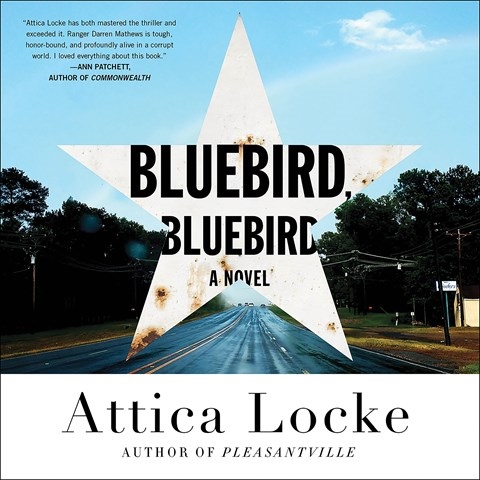
Attica Locke, Bluebird, Bluebird, Serpent’s Tail, 2017
Opening line: Darren Mathews set his Stetson on the edge of the witness stand, brim down, like his uncles taught him.
I’d heard a number of good things about this novel set in East Texas, and found it a rich and absorbing read. Darren Mathews is a black Texas Ranger whose work takes him all across the state, often to isolated communities marked by racial tensions. After becoming too closely involved in a friend’s case, he’s sent to the small town of Lark, where the murders of a local white woman and a black man from Chicago are making waves. While his prestigious status as a Texas Ranger will offer him some protection from the racist forces in the town, he knows he’ll need to keep all his wits about him to stay in one piece.
Bluebird is a finely observed novel that shows us rural America from a range of black American perspectives. Mathews, our lead investigator, is particularly well drawn. Brought up in a highly educated middle-class family, he feels pulled between a safe career in law and his desire for a more hands-on law enforcement role. Deeply conflicted about Texas and the profound racism he encounters, he also has a deep love of the place and its people. His views are complemented by a range of other black voices, such as Geneva Sweet, the sixty-nine-year-old owner of Geneva Sweet’s Sweets, a cafe offering ‘the best fried pies in Shelby County’. Her family story is one that has probably played out hundreds of times in American history, and is deeply moving.
You can read an extract from the novel at the Serpent’s Tale website.
A brief extra observation: a recent discussion on Facebook explored the lack of black crime bloggers and readers at UK crime conventions and publishing events, and led to a wider discussion about black crime authors. There really aren’t that many big names (Walter Mosley most obviously springs to mind), and it is notable that recent crime novels exploring black American experience (such as Thomas Mullen’s excellent Darktown) are often written by white authors. All the more reason to be delighted that Attica Locke is such a crime writing success story.

Oliver Bottini, Zen and the Art of Murder, trans. from the German by Jamie Bulloch (MacLehose Press, 2018 [2004])
Opening lines: Louise Boni hated snow. Her brother had died in the snow, her husband had left her in the snow and she had killed a man in the snow.
Zen and the Art of Murder is the first in Oliver Bottini’s ‘Louise Boni’ series, and is set in the Black Forest region of south-west Germany. It opens with a rather unusual sight: a Japanese monk, dressed only in a robe and sandals, is wandering through the snow. He is injured, but doesn’t seem to want official help, accepting only a cheese roll before trudging on through the snowy landscape. When Boni and her local police contacts follow him to find out what’s going on, the mystery suddenly takes a frightening and serious turn.
On one level, Zen is a police procedural that shows us the inner workings of a police investigation and the sometimes fraught dynamics of a police team investigating a stressful case. But the figures of the Zen monk and chief inspector Louise Boni – who is dealing with personal demons, traumatic memories from a previous case and borderline alcoholism – give the narrative a fascinating off-kilter feel. Much of the novel is seen from Boni’s embattled perspective, as she struggles to piece things together with unshakeable determination and undoubted investigative talent. The result is a highly unusual and beguiling police procedural, whose complex lead protagonist will stay with you for a long time to come.
Oliver Bottini is appearing on a special Krimi panel at this year’s CrimeFest – of which more soon!

Karin Brynard, Weeping Waters, trans. from Afrikaans by Maya Fowler and Isobel Dixon
Opening lines: The call came through just after two. He was at his desk at the police station, having his lunch of vetkoek and mince.
Like Zen’s Louise Boni, Inspector Albertus Beeslaar is a traumatised cop. Haunted by the consequences of a case gone wrong, he has fled the big city of Johannesburg for a small town on the edge of the Kalahari desert. Already dealing with a spate of stock thefts in farms around the area, he now receives a call telling him that a local artist, Frederika Swarts, has been found murdered on her family farm, along with the four-year-old child she was planning to adopt. He embarks on the investigation with rookie policemen Ghaap and Pyl, while fighting off ever more frequent panic attacks.
While I found some parts of Weeping Waters a little uneven, there also was much to like. The characterisation of Beeslaar and of Freddie’s estranged sister Sara are excellent, and the latter’s struggle with guilt and grief is particularly well drawn. The novel also has a fantastic sense of place: the incredible heat and vastness of the desert landscape are brought vividly to life, as is the claustrophobic nature of small-town life. There’s also a good attempt to explore on-going racial tensions in post-Apartheid South Africa – for example how the murders of white farmers are exploited for political gain by right-wing factions. I also very much appreciated the translators’ approach to rendering the Afrikaans dialogue – the syntax and vocabulary are kept close to the original in such a way that you can really hear the characters’ voices and appreciate their local culture.
The novel is the winner of the University of Johannesburg Debut Prize, and is the first in a series.
 Mrs. Peabody Investigates