Interview with Simone Buchholz: Hamburg Noir and why everyone needs a ‘beer family’

It’s my pleasure to welcome German crime writer Simone Buchholz to the blog today. Simone is based in in the northern city of Hamburg and is the author of the highly acclaimed ‘Chastity Riley’ series, which draws on private-eye conventions to create stylish, urban noir with a German twist. Blue Night (Blaue Nacht) is her English-language debut, beautifully translated by Rachel Ward and published by Orenda Books.
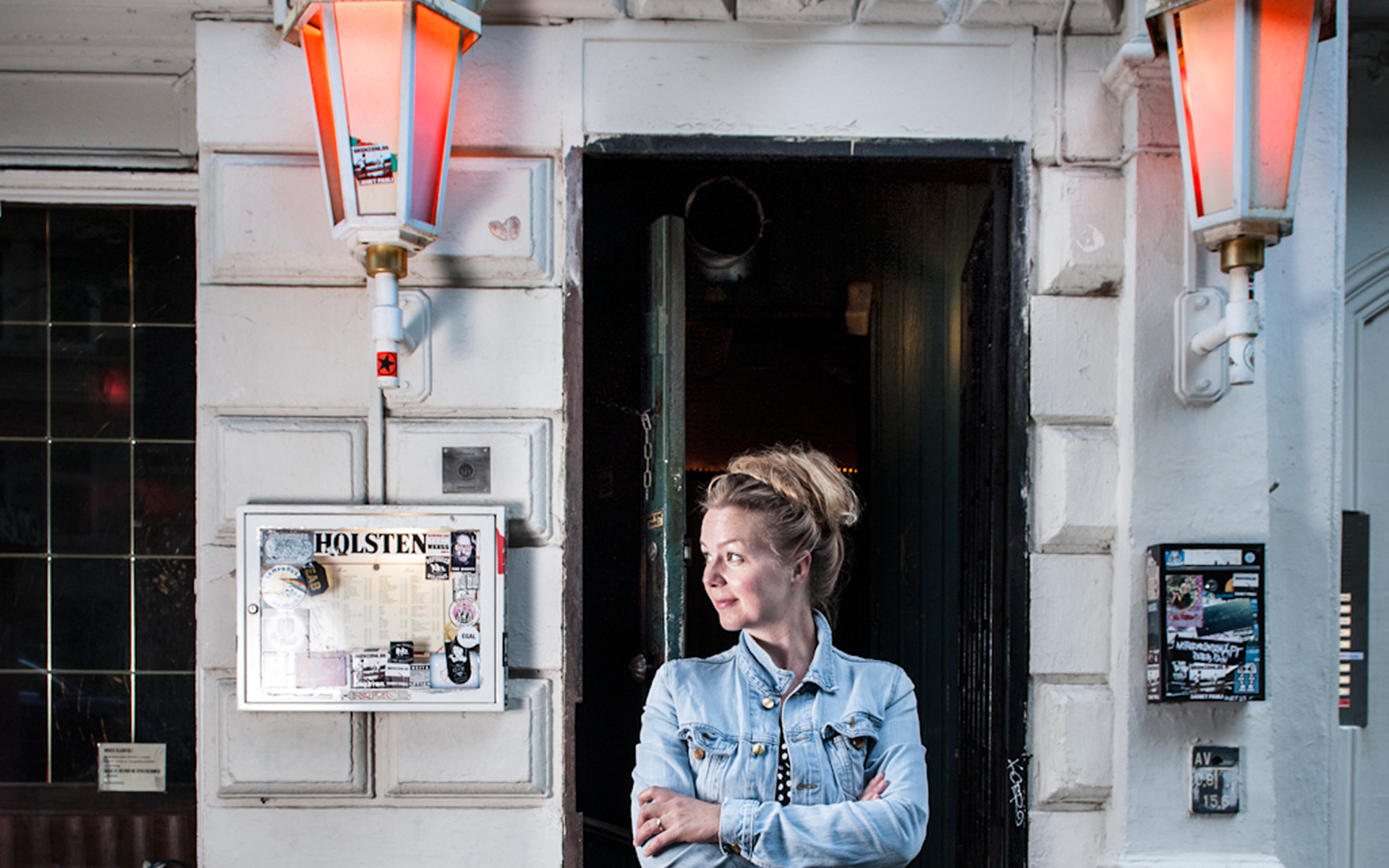
German crime writer Simone Buchholz

At the beginning of Blue Night, we join Hamburg state prosecutor Chas Riley as she hits a career low. After an unfortunate incident involving a gun and a gangster’s crown jewels, she’s been shunted off to witness protection, a job she finds increasingly dull. But all that changes when she’s assigned the case of a badly beaten man with a missing finger, who is oddly reluctant to divulge his identity. Chas is up for the challenge, and so the investigation begins, with the help of her loyal group of St. Pauli friends.

First line: A kick in the right kidney brings you to your knees.

Mrs P: Simone, welcome to the blog and thanks for agreeing to be interviewed (in English to boot!). Your lead investigator, Chastity ‘Chas’ Riley, has an unusual family background. Why did you opt to give her a German mother and an American father who was a former GI?

Simone: I grew up in southern Germany near Frankfurt, and when I was a child there were still a lot of US Army soldiers in our little city. There was even a real American quarter in town, with bigger streets, bigger cars, basketball cages, the whole American lifestyle. And there were also the children of these GIs – but mostly without fathers because GIs normally returned to the US as soon as one of their German girls got pregnant, it was some kind of army policy. To me these children (who were at school with us) always seemed homeless and maybe this shaped a part of my soul.

So when I was looking for a main character for my crime novels I remembered these children and I always liked the American way of storytelling. Riley came to me really quickly and quite naturally.

Mrs P: What made you gravitate towards the noir form when writing the ‘Riley’ series and Blue Night?

Simone: I think at first it just was the noir sound I wanted to use. And then I thought: if I want to tell stories about our society I’ll have to look in the dark corners of life. Once you start doing this, you just can’t stop. It transforms the way you look at mankind. For me, it’s the most interesting way of telling the truth.

“Killer eyes. Killer legs. Killer instincts. A private detective with a name as tough as she is.”

Mrs P: Who are your literary inspirations? American authors of hard-boiled crime, like Chandler and Hammett? Sara Paretsky (author of the ‘V.I. Warshawski’ series) and Jakob Arjouni (author of the ‘Kayankaya’ series)? Or others?

Simone: The first real literature I read was Hemingway – I found his books on my father’s bookshelf, and I really loved the sound and the way Hemingway showed the inner world of his characters by just letting them compose their drinks. Then came Chandler. And then – yes! – a V.I. Warshawski movie with the fabulous Kathleen Turner. Finally Jakob Arjouni appeared. The way he transformed this classic American hard-boiled sound into a German city [Frankfurt] and red light district was hilarious. When I took my first steps in crime writing ten years ago I always had all of this stuff in mind. And I just tried to do something like that. I wish Arjouni was still alive. I would definitely try to talk to him about his work.

[For an overview of Arjouni’s work, see my earlier blog post here.]

Mrs P: Hamburg, and in particular the famous St. Pauli district, is vividly depicted in Blue Night – which I loved, having spent a happy year living there back in the 1980s. Can you tell us a little about these locations and the role they play in your series?

Simone: The district of St. Pauli, as it comes to life in my novels, is a romantic, very personal version of the real St. Pauli. Some kind of secure place where souls can recover from what’s going on outside the bars and clubs. It’s the place where my characters hide from the world and try to heal their wounds with alcohol, music and cigarettes.

And not forgetting the big harbour we have here, which is very special. It’s the open, wild side of the city. A perfect place for everything to take place in a crime novel.
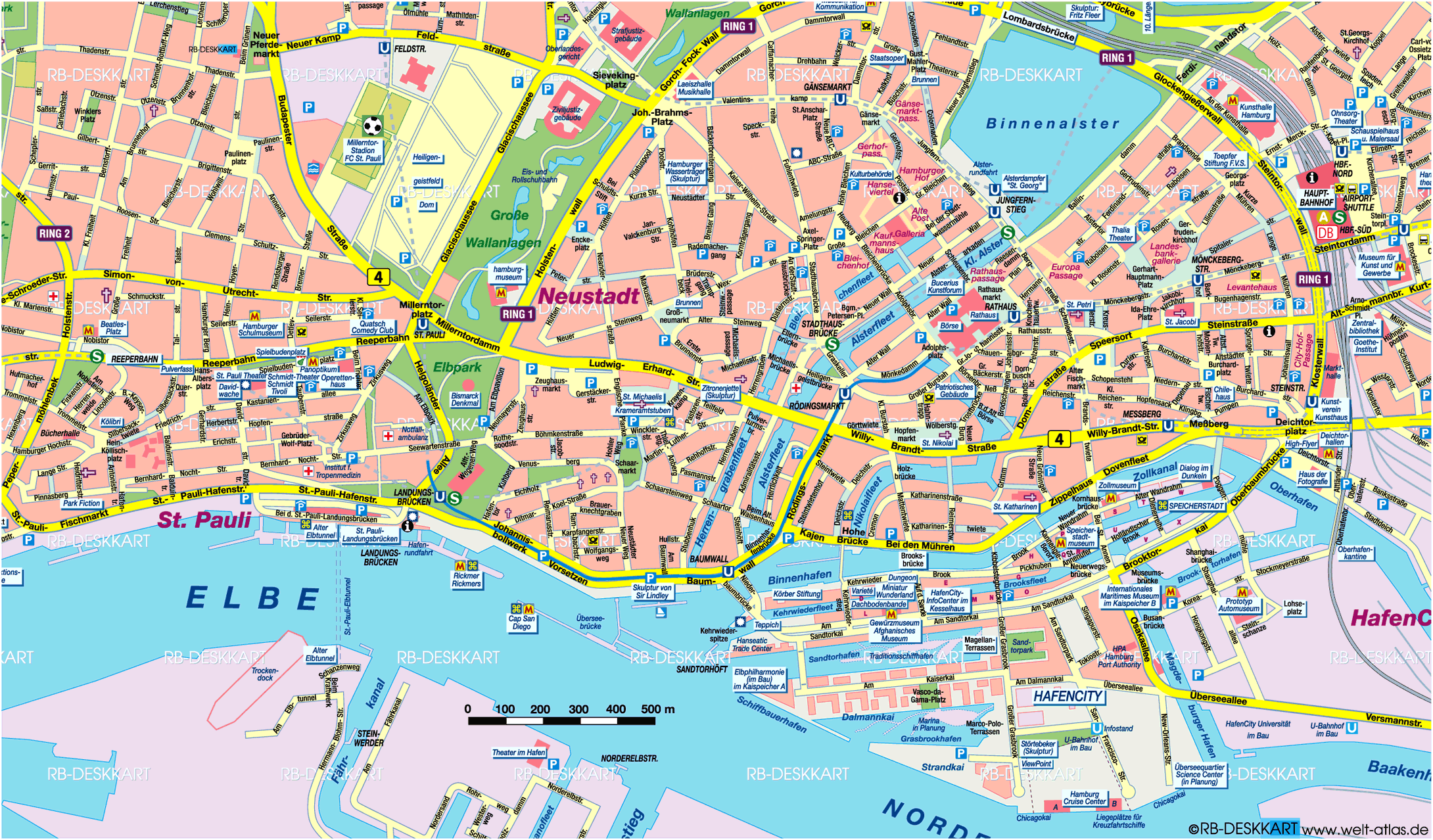
Map of Hamburg, with the district of St Pauli on the left-hand side, near the city’s port and the River Elbe.

Mrs P: A theme that really shines through in the novel is that of friendship. Are friends the new family in a fragmented, globalized world?

Simone: Before I met my husband, before our son arrived, I often felt a great loneliness – though it didn’t cause me too much suffering. It was OK. But with my parents 500 kilometers away, I had to build some kind of family around me in the big city with the big harbour. I found this family in the bars and it still exists. I meet my beer family at least once a week; it helps me with everything and I’d recommend this to everyone, especially today in these speedy times. If you sit at a bar, having a long deep talk with somebody (with rain outside) – it makes you quiet and calm.

Mrs P: Do you have any favourite German-language crime writers that you’d recommend to UK readers?

Simone: Jakob Arjouni, for sure. And my good friend Friedrich Ani. Bittersweet sound, stories from hell.

Thanks, Simone! There are further reviews and features on Blue Night blog tour.

An extract from the novel is available over at Reading for Pleasure.

Rachel Ward has also written a very interesting post on her experience of translating Blue Night. She illustrates the crucial role that translators can play in championing international literature and bringing novels to UK publishers’ attention.

Friday afternoon treats: Friis’ What My Body Remembers (DEN), Ramqvist’s The White City (SWE), Verdan’s The Greek Wall (SWI), BBC 2’s Collateral (UK)

I’m in the thick of my 2018 Petrona Award reading at the moment, and have chanced on two quite unusual submissions. While different books in many respects, both are gripping explorations of what it’s like to be a mother in traumatic circumstances.

Agnete Friis, What My Body Remembers (trans from Danish by Lindy Falk van Rooyen; Soho Crime, 2017). First line: “Can’t you get him to shut up at night?”

This standalone novel takes us into the world of Ella Nygaard, a 27-year-old single mother who’s struggling to make ends meet while dealing with the fallout of her own traumatic past – she was made a ward of state at the age of seven after her father murdered her mother. Ella suffers from PTSD panic attacks and strange physical symptoms that she can’t quite decode. When the state threatens to place her son Alex in care, she takes decisive action. But the price of keeping Alex with her is a return to the seaside town in northern Denmark where she was brought up, and a confrontation with the traumatic events of the past.

I really liked this novel. Ella is a great character – traumatised but tough – and the book gives a sobering insight into the strains of living on the edges of poverty and under the constant gaze of a state that can take your child away from you. Ella’s physical symptoms are used very effectively to show the severity of her trauma, but are cleverly also clues to the mystery of what happened the night her mother died twenty years before. While some aspects of the novel’s ending might make you raise an eyebrow, this is a very well-written, gripping thriller that stays with the reader thanks to Ella’s characterisation (shades here of Gillian Flynn’s resilient heroine in Dark Places).

Karolina Ramqvist, The White City (trans from Swedish by Saskia Vogel; Grove Press, 2017). First line: ‘It was the end of winter’.

This novella tells a tale normally lost in the margins of gangster stories: the fate of women who are left behind by their gangster husbands when things go wrong. Here, the woman in question is Karin, whom we meet a few months after the disappearance of her husband John. Gone is the high-flying life she used to enjoy on the proceeds of her husband’s criminal activities. All that’s left now is a once-grand house, serious financial difficulties, and government agencies closing in. Oh, and a baby that Karin never actually wanted to have.

The White City is a raw, but utterly compelling portrait of a woman at rock bottom, and her efforts to heave herself out of a state of despair. As in What My Body Remembers, Karin’s body becomes a symbol of a life that’s out of control. I’ve rarely seen the physical realities of motherhood described in such unvarnished, powerful terms in a literary work.

Nicolas Verdan, The Greek Wall (trans from French by W Donald Wilson; Bitter Lemon Press, 2018). First line: ‘In normal circumstances he’d have gone on his way’.

Nicolas Verdan’s debut, The Greek Wall, is a truly European novel. Its author is a French-speaking Swiss journalist who divides his time between Switzerland and Greece. It’s set partly in Athens – the symbolic heart of the Greek political and economic crisis – and partly on the Greek-Turkish border, where the river Evros is a favoured crossing point for immigrants trying to enter the Schengen Area. Its characters are Greek, Turkish, German, Finnish and Russian.

When a severed head is discovered on the Greek-Turkish border by a Frontex patrol, Agent Evangelos of Greek Intelligence is sent to investigate, and finds himself embroiled in a politically sensitive case that exposes the realities of power, corruption and illegal immigration. Verdan draws heavily on the true story of the wall (actually a 12.5 kilometer barbed-wire fence) erected by Greece along the Evros in 2012 (an interesting article on it here by EU Observer, with a handy map).

I particularly liked the character of Evangelos, who’s a veteran of turbulent Greek politics and has his own murky past, and the novel’s lyrical style, which is at times dreamy and looping, like the thoughts of its investigator, and at times brutally frank about Fortress Europe, and the way that nationality and wealth so often dictate people’s life chances. The ending is neat too.

A bit of exciting telly news for those in the UK. Next Monday, 12th February, sees the start of a new four-part series on BBC 2 that looks very promising indeed.

Political thriller Collateral is scripted by playwright David Hare (the David Hare) and features an absolutely stellar cast. Along with the fabulous Carey Mulligan, who plays Detective Inspector Kip Glaspie, there’s an ensemble cast including John Simm, Nicola Walker and Billie Piper. I know!!!

Set over four days in London, Collateral explores the consequences of the fatal shooting of a pizza delivery man.

David Hare says of the series: 

‘At its start, Collateral may seem to be familiar. After all, it does involve a police investigation. But I hope you will notice the absence of any of the usual apparatus of police procedurals. […] After an illegal immigrant is shot in the opening moments, I am much more interested in exploring how the death of one individual, who has lived out of the sight of respectable society, resonates and reaches into various interconnecting lives.’

Carey Mulligan adds:

‘There is such a scarcity of great writing for women and this drama has so much. It is happening much more in TV than in film, but it is still rare to have this many well rounded female characters in one drama, and what I love is that they are not all likeable – they are flawed, three-dimensional, real people. Often women are encouraged to be amenable, likeable characters and these women are much more than that, they have so much going on which is really exciting.’

Read the full interview with David Hare here, the full interview with Carey Mulligan here, and an overview of the series at the BBC’s Media Centre here.