Mina’s The Long Drop (Scotland), Broadribb’s Deep Down Dead (UK/USA), le Carré’s The Pigeon Tunnel (UK/world)

This ‘read exactly what you want to read’ thing is working out really well. Three crackers for you this week:
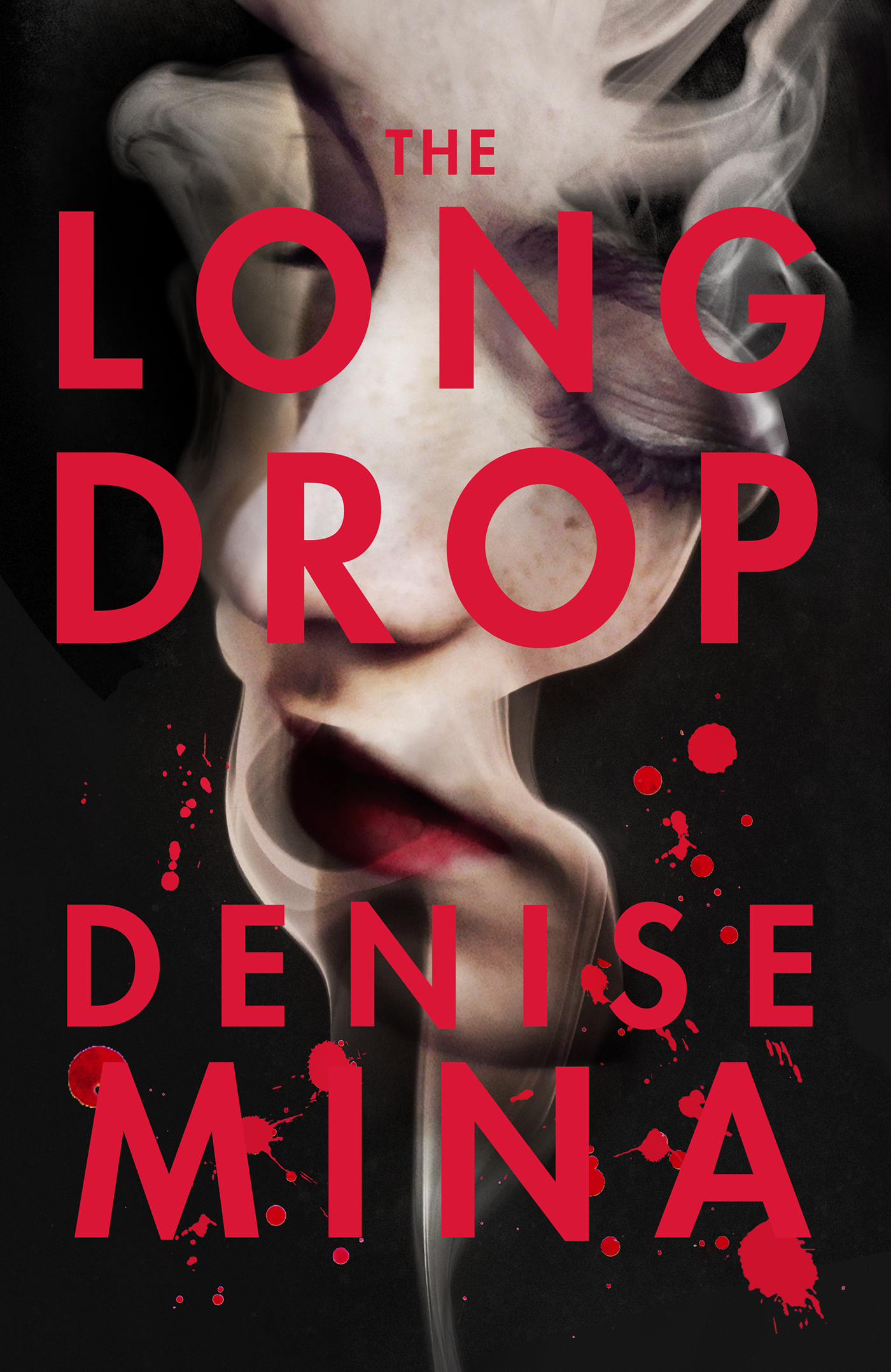
Denise Mina, The Long Drop (Harvill Secker, 2017)

First linesHe knows too much to be an honest man but says he wants to help. He says he can get the gun for them.

I’ve loved everything I’ve read by the supremely talented Scottish writer Denise Mina, and The Long Drop is no exception. Based on the true case of rapist and murderer Peter Manuel, it’s a highly original re-telling of the circumstances leading up to his trial and judicial reckoning, set in a grimy, rough 1950s Glasgow.

Often these kinds of literary/true crime hybrids will focus on ‘why and how’ a criminal came to carry out his or her crimes (see for example my recent review of Carrère’s The Adversary). Such approaches are often fascinating, but what makes The Long Drop stand out is the originality of its storytelling, which expertly weaves together two contrasting narrative strands. The first shows a long night of drinking by Manuel and businessman William Watt in various Glasgow bars and establishments. Watt is the husband, father and brother-in-law of three of Manuel’s murder victims, and meets Manuel in the hope of gaining a crucial piece of evidence. It’s a cat-and-mouse game with some genuine surprises, which also takes us on a tour of the ‘old’ Glasgow before the slum clearances and remaking of the city centre (you can trace their wanderings on the map on the inside cover). The second narrative strand explores Manuel’s trial and the public/media interest in the case. It’s equally fascinating, not least due to Manuel’s misguided decision to dispense with his legal representation and do the job himself.

I found the entire book unexpectedly gripping, and the quality of the writing and characterisation are sublime. Mina doesn’t shy away from describing Manuel’s horrific crimes, but her approach is never salacious, and she provides razor-sharp dissections of masculinity and class along the way. Highly recommended.

You can read an extract from the beginning of The Long Drop over at DeadGoodBooks.

Steph Broadribb, Deep Down Dead (Orenda Books, 2017)

First line: I open my eyes and the first things I see are the cuffs.

I’ve never been much good at dealing with Mild Peril. Even watching kids’ films like Finding Nemo, in which a small fish lurches from one mildly threatening situation to another, required the steadying hand of my small son. For that reason, I don’t tend to read thrillers packed with Major Peril. Every now and then, however, I’ll be tempted to throw caution to the wind, as was the case with Steph Broadribb’s Deep Down Dead. I’d heard Steph read an extract from the novel at Newcastle Noir, and liked the sound of her sassy heroine, Florida bounty hunter Lori Anderson, very much.

Deep Down Dead is a genuinely accomplished debut novel. Steph is a UK author, but convincingly pulls off a Stateside setting and dialogue, and famously shadowed a real bounty hunter as part of her research, in order to learn the trade first-hand. I love the character of Lori, a thirty-something single mother, whose need to pay off her nine-year-old daughter’s medical bills leads her to take the job of collecting a wanted man in West Virginia. Except the man turns out to be J.T., her old flame and mentor, and the lack of a babysitter means she has to take daughter Dakota along – into a less than child-friendly environment. Trouble quickly ensues. The dialogue is snappy, the action high-octane, and Lori’s dual identity as bounty hunter and parent makes her the ultimate multi-tasking mom – and a very likeable one at that. A wonderfully entertaining summer read.

John  le Carré’s The Pigeon Tunnel. Stories from my Life (Viking, 2016)

First lineThere is scarcely a book of mine that didn’t have The Pigeon Tunnel at some time or another as its working title.

I count myself as one of John le Carré’s biggest fans (see my appreciation here), so reading his memoir The Pigeon Tunnel was a treat of the highest order. The author has a reputation for being a brilliant raconteur, and the reading the book’s 38 chapters felt a bit like being at a dinner where the great man is holding court.

There are fascinating takes on key moments of Cold War history (West German Chancellor Adenauer’s failure to remove former high-ranking Nazis from post-war political structures; Russia before and after the collapse of Communism), wonderful anecdotes about actors and directors (Alec Guinness, Richard Burton, Sydney Pollack, Stanley Kubrick), stories about the people who inspired his characters (such as Yvette Pierpaoli, who became Tess in The Constant Gardener), and the extensive research trips for novels such as The Little Drummer Girl (resulting in a dance with Yasser Arafat). And of course, there are insights into the complex, murky world of spying, and in particular the Kim Philby case – the British intelligence officer who was unmasked as a Russian spy in 1963. The stories are by turns illuminating, moving and hilarious – I found myself laughing out loud a great deal, which wasn’t something I’d expected at all. If you’re a fan of le Carré, the memoirs really are a must-read.

I’m now keen to re-read some of le Carré’s novels, and to tuck into Adam Sisman’s biography of the author, which is waiting patiently for me on a shelf.

You can read an extract from The Pigeon Tunnel here, involving Alec Guinness, former Chief of the Secret Service Maurice Oldfield, and some authorial guilt. Other extracts are available from The Guardian here, both from The Pigeon Tunnel and the author’s novels (beautifully read by a cast of famous actors).

Koutsakis’ Athenian Blues (Greece), Stanley’s A Death in the Family (Botswana), Bradbury’s Fahrenheit 451 (USA)

This week’s crime reading took in Greece, Botswana and America.

Pol Koutsakis, Athenian Blues, translated from Greek by Pol Koutsakis (Bitter Lemon Press, 2017)

Opening line: A few of them were kicking and screaming, but most of the immigrants followed orders, as the police shoved them out of the building.

Athenian Blues is Koutsakis’s debut crime novel and the first in his ‘Stratos Gazis’ series. Its main protagonist is a contract killer with a conscience, who is aided in his investigations by childhood friends Drag, a homicide cop, and Teri, a transgender sex worker. When Stratos is asked to carry out a hit by a beautiful Greek actress who promptly disappears, he and his friends are pulled into an increasingly baffling case.

This novel left me with mixed feelings. I enjoyed the first-person, private-eye narrative, which makes effective use of hard-boiled PI conventions, and the quirky depictions of Stratos and his friends. The novel also makes the most of its contemporary Athens setting, providing interesting insights into recent Greek political and economic crises. However, I found being asked to identify positively with a hitman a bit of a stretch. Stratos is given a moral legitimacy reminiscent of popular TV killer Dexter (he only bumps off those who truly deserve it), and his friends seem to have no problem accepting his profession, due to their past experiences and the social upheavals of the present. And everyone seems to end up in bed with everyone else *yawn* (I am clearly getting old). An entertaining summer read, as long as you don’t take it too seriously…

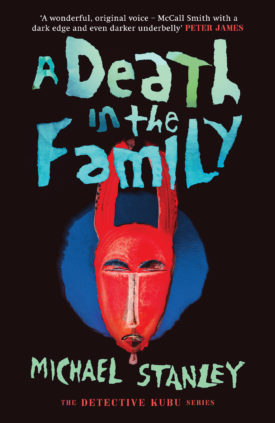
Michael Stanley, A Death in the Family (Orenda Books, 2016).

Opening line: Assistant Superintendent David ‘Kubu’ Bengu was enjoying his dream.

A Death in the Family is the fifth in the ‘Detective Kubu’ series, co-written by Michael Sears and Stanley Trollip. Originally from South Africa, they decided to start writing after a trip to neighbouring Botswana, where Alexander McCall Smith’s ‘No. 1 Ladies’ Detective Agency’ series is of course also set. While the ‘Kubu’ series portrays Botswana in a warm light, it also paints a more nuanced (and decidedly less twee) picture of modern Botswana life than McCall Smith. In this novel, Kubu has to deal with his most distressing case yet – the murder of his own father Wilmon – and two other cases that highlight the potentially mixed effects of foreign mining investments. The plot is highly satisfying, the characters engagingly drawn, and readers come away with a rich understanding of Botswana’s history and culture – from traditional funeral rites to the role of the tribal kgotla. There’s a handy glossary of Setswana phrases included at the back of the novel as well.

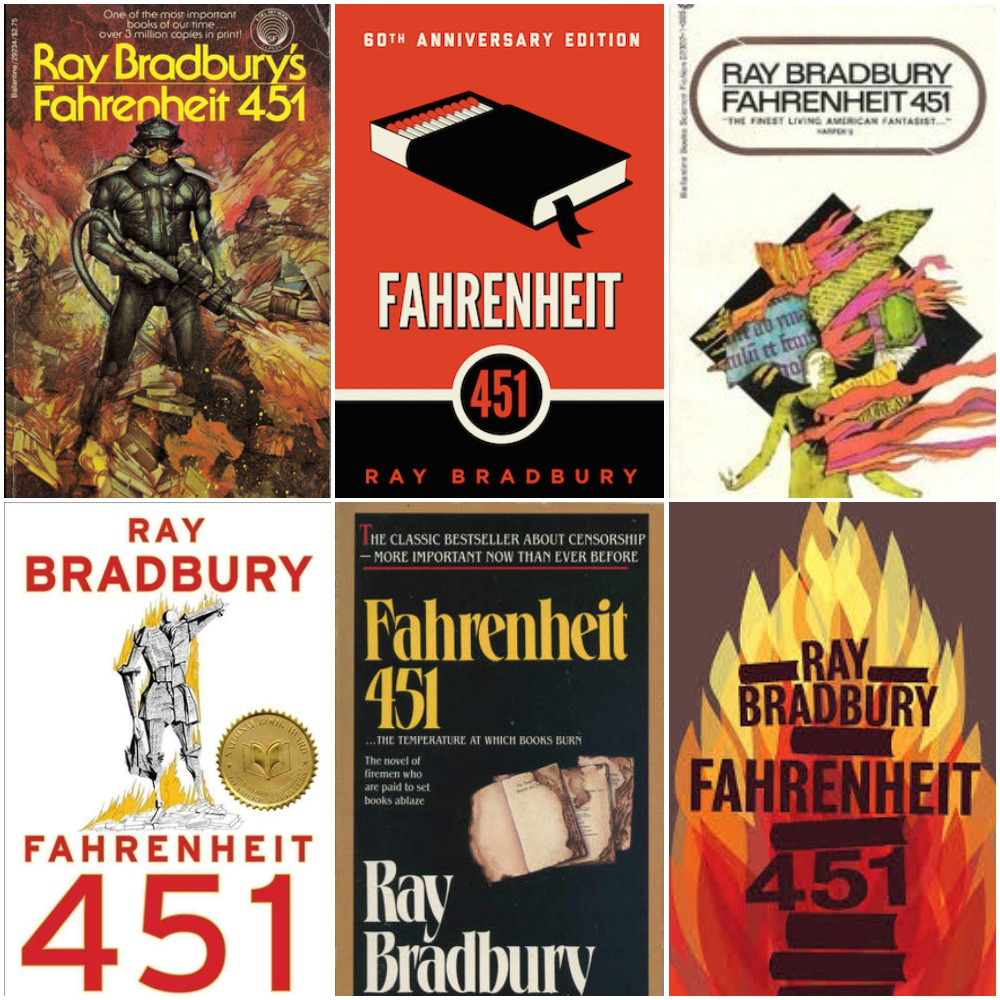
Ray Bradbury, Fahrenheit 451 (originally published 1953; Audible book narrated by Tim Robbins)

Opening line: It was a pleasure to burn.

I’m always looking out for audiobooks to accompany my knitting, and jumped at the chance to listen to Fahrenheit 451, an American classic I’d never read. Like Margaret Atwood’s The Handmaid’s Tale, Fahrenheit 451 is a dystopian novel: it depicts an American future in which books are viewed as subversive, and reading or owning them has become a criminal offence (everyone is plugged into mind-numbing, round-the-clock entertainment provided by state radio and TV instead). The task of firemen in this society is not to put out fires, but to burn books – which catch alight at 451 degrees Fahrenheit.

The novel traces the evolution of Guy Montag, a fireman who is an unquestioning part of the system, following a chance encounter with Clarice McClellan, an intelligent, free-spirited teenager. Written in 1953, the novel is remarkably prescient, exploring the negative effects of advanced technology on social interaction, and asserts the fundamental right to question, challenge and advance ideas in literature and debate. There’s a highly charged murder in the novel as well, which has emboldened me to include it on the blog.

I can fully see why Fahrenheit 451 is regarded as a classic. The story is simply and sparely told, but communicates incredibly powerful ideas. If I’m not mistaken, Bradbury draws on one particular biblical story at the end (I won’t say which, as it would give too much away), and provides a chillingly realistic depiction of what it might be like to resist a repressive regime. There was only one moment where I felt the novel truly showed its age (again, slight spoiler; ask me to say more in the comments if you’re curious).

So how’s my TBR cull going? The scores on the doors are as follows:

Subtracted – 5

Added – 3

Progress of sorts…?

Thomson’s Ghost Girl (UK), Carrère’s The Adversary (France), The Handmaid’s Tale (Canada/US)

My TBR pile is well and truly out of control at the moment, so I’m going to have a reading blitz over the summer to reduce it as much as I can. My approach will be threefold: ruthlessly cull the books that don’t appeal to me (life is too short), read exactly the books I want to from the pile that is left, and write up a variety of short reviews for the blog. And, as is the case this week, I might add in the odd TV series or other random delight from time to time.

Lesley Thomson, Ghost Girl (Head of Zeus, 2014)

Opening line: ‘In the pale light the girl might be a ghost risen from one of the graves’.

I really liked the first in Thomson’s series, The Detective’s Daughter. It took me a little while to get into this second novel: slightly more signposting was needed at the beginning to help readers navigate the two timelines. However, I remained captivated by the character of Stella Darnell, the police detective’s daughter who picks up his unsolved cases after his death. Stella runs a cleaning agency and is more like her father than she would care to admit – her drive to restore order makes her a very tenacious and thorough investigator. In this case, a set of photos in her father’s cellar showing deserted London streets puts Stella on the trail of a murderer. Her investigative partner Jack Harmon is equally intriguing – a night-time tube driver whose life, in contrast to Stella’s, is governed by signs and intuition rather than rationality. Both are social misfits, but together they make a great team. Another strength of both books is Thomson’s depiction of the inner life of children and how they try to make sense of traumatic situations.

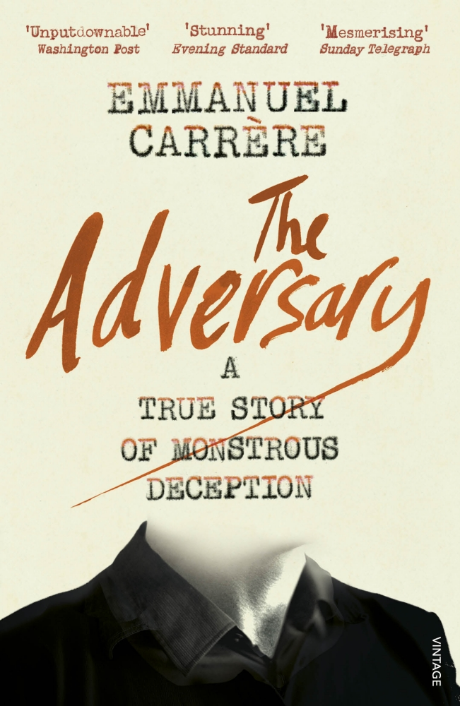
Emmanuel Carrère, The Adversary: A True Story of Monstrous Deception, translated from French by Linda Coverdale (Vintage, 7 July 2017 [2000]).

Opening line: ‘On the Saturday morning of January 9, 1993, while Jean-Claude Romand was killing his wife and children, I was with mine in a parent-teacher meeting at the school attended by Gabriel, our eldest son’.

Emmanuel Carrère is a well-known writer, who here dissects a highly disturbing true crime: Jean-Claude Romand’s murder of his wife, two children and elderly parents in 1993. The book is both an archaeological excavation of the events leading up to the murders and the multiple deceptions Romand wove over twenty years. While to his family and the outward world he appeared to be a respectable, well-to-do doctor working for the World Health Organisation, in reality he was nothing of the sort. Carrère effectively explores how Romand deceived and betrayed his family, and the ways in which his lies corroded his own identity, creating a terrifying void. Hard-hitting and thoughtful, but avoiding sensationalism, Carrère makes no excuses for the murderer’s mythomania and his attempts to escape the consequences of his crimes. A fascinating, but utterly chilling read.

The Handmaid’s Tale (Hulu/Channel 4), adapted from Margaret Atwood’s The Handmaid’s Tale (Vintage, 1996 [1985])

American viewers are ahead of us here in the UK, where the highly anticipated TV adaptation of The Handmaid’s Tale began to air last Sunday. The novel, of course, is not crime fiction, but ‘speculative’ fiction that portrays a theocratic America of the near future, and famously draws on a range of repressive historical examples (from seventeenth-century Puritan America to twentieth-century regimes such as Nazi Germany and Ceaușescu’s Romania). But the themes of crime and criminality are at the very heart of the novel: how totalitarian/ultra-religious states criminalise any form of dissent, and how in particular they police women’s behaviour, driving them out of the public sphere and back into a private space where their identity, sexuality and bodies are heavily controlled. In the process, of course, the state itself becomes criminal, because it is denying its citizens the most basic of rights. The novel has long been on my ‘most influential books of all time’ list, and the TV opener did a brilliant job of bringing its dystopian vision to life. Elisabeth Moss is outstanding as the narrator and central protagonist, Offred.

Here’s a wonderful recent essay on the novel by Margaret Atwood for the New York Times: ‘Margaret Atwood on What ‘The Handmaid’s Tale’ means in the Age of Trump’.