
My reading since New Year has been very eclectic. As a result, there’s no neat way for me to link the following novels: they’re a tasty smörgåsbord of different crime writing styles, subjects and approaches.

First up is Peter Bartram’s delightful Brighton cosy Headline Murder (Roundfire Books, 2015). Set in 1962, it follows journalist-sleuth Colin Crampton as he investigates the sudden disappearance of Krazy Kat miniature-golf-course owner Arnold Trumper. As one would expect from this pre-internet setting, the investigation involves lots of hands-on detective work, which simultaneously provides an intriguing insight into a 1960s journalist’s life (complete with amusing rivalry between the Brighton Evening Chronicle and the Brighton Evening Argus). While it took a couple of chapters to get into its stride, I found the novel a highly enjoyable and well-crafted read, with a host of engaging characters. It’s a very good choice if you need a break from the darker recesses of noir or the modern world. Favourite line: ‘Ten minutes later I was in the Evening Chronicle‘s morgue with a large bag of jam doughnuts’.
The novel is the first in the ‘Crampton of the Chronicle’ series, and there are some free short stories available too. ‘Colin’ has a nice website that’s worth a visit (and hats off to author Peter Bartram – who has a background in journalism – for this very neat bit of marketing).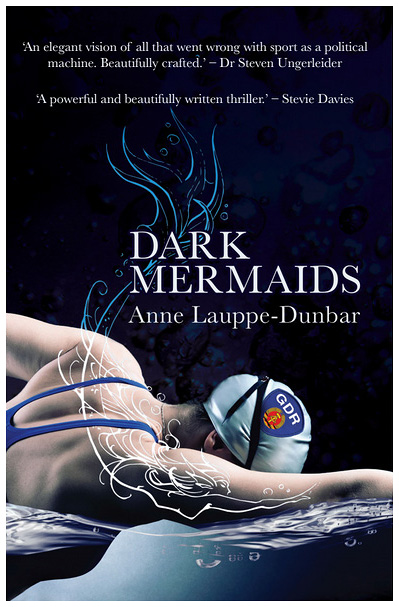
Anne Lauppe-Dunbar’s Dark Mermaids (Seren, 2015) is an absorbing debut that’s tricky to categorise: a literary-historical crime novel, perhaps. Set at an intriguing moment in German history – 1990, just a year after the fall of the Berlin Wall – it shows national and individual identities in flux, and the full extent of Stasi (East German secret police) activity beginning to emerge. However, its central focus is the GDR’s shameful use of steroids on young swimmers and the after-effects of that state-sanctioned abuse (here’s a BBC article with a good overview of the scandal). I very much liked the novel’s sensitive depiction of emotionally damaged police officer Sophia Künstler, and how it explores the political complexities of East German everyday life.
Anne is a lecturer in creative writing at Swansea University, and was partly inspired to write the novel by her German family roots.

Stanley Ellin’s The Speciality of the House (Orion, 2002), is part of Orion’s wonderful ‘crime masterworks’ series. A collection of the renowned New York author’s mystery tales from 1948 to 1978, it presents a deliciously dark vision of society. I’m not always a fan of the short story form, but Ellin is a brilliant writer with a gift for criminal invention. His murderers are often outwardly respectable citizens trying to solve financial problems or to climb the social ladder, and there’s a wicked sense of humour at play.
The subject of marriage also gets wry treatment, as this wonderful opening from ‘The Orderly World of Mr Appleby’ (1950) demonstrates: ‘Mr Appleby was a small prim man who wore rimless spectacles, parted his graying hair in the middle, and took sober pleasure in pointing out that there was no room in the properly organized life for the operations of Chance. Consequently, when he decided that the time had come to investigate the most efficient methods for disposing of his wife, he knew where to look’.
I found Speciality by chance while browsing in Swansea’s Oxfam Books – testimony to the pleasures of browsing and finding something completely unexpected, as opposed to being steered towards a predictable set of books by an online retailer’s algorithm…
 Mrs. Peabody Investigates