
Leif G.W. Persson, Between Summer’s Longing and Winter’s End: The Story of a Crime, trans. from the Swedish by Paul Norlen (London: Black Swan, 2011 [2002]). An epic crime novel and bravura account of one of Sweden’s greatest unsolved crimes 4 stars
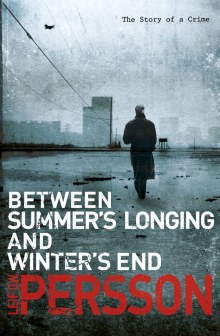
Opening line: The best informant is the one who hasn’t understood the significance of what he has told.
Like Peter Høeg’s Miss Smilla’s Feeling for Snow, this novel opens with an unexplained fall from a tall building in the freezing depths of a Scandinavian winter. In the case of Persson’s Between Summer’s Longing and Winter’s End, the casualty is a young American, John Krassner, whose death is initially presumed to be suicide, but might well be something more sinister – for how to explain the fact that his shoe hit the ground a good ten seconds after his body?
For a significant portion of the text, the reader might reasonably assume that Krassner’s death is the ‘crime’ referenced in the novel’s subtitle. However, as the narrative unfolds over a sprawling 638 pages, it becomes clear that his demise is linked to a much larger crime – one that took place in Sweden in 1986 and remains unsolved to this day. If you can’t quite remember that event, I’d advise you to stay away from reviews until you’ve finished the book (my reading experience was considerably enhanced by putting two and two together at a relatively late stage – the biggest ‘OMG’ reading moment I’ve had in years). But if you can’t wait, or are looking for illumination after reading the novel, click here…
In common with a number of Swedish crime authors since the 1960s, Persson has a rather jaundiced view of Swedish society and is highly critical of the authorities and the power wielded by the state. The police are depicted as racist or misogynist bunglers, with the Swedish secret police force (Säkerhetspolisen or Säpo) shown in a particularly harsh light. What makes the strength of this critique startling and more than a little interesting is the author’s own long-held position within the Swedish establishment. As the blurb on the inside front cover tells us, Persson has enjoyed an eminent career as ‘Scandinavia’s most renowned criminologist and leading psychological profiler’, as well as being an advisor to the Swedish Ministry of Justice and a professor serving on the National Swedish Police Board. It would be interesting to know how these august bodies reacted to the very negative depictions of the state and its law enforcement agencies within the novel.
One of the few likeable figures in the book is Superintendent Lars Martin Johansson, the ‘honest Swedish cop’ who digs the deepest into Krassner’s death. But even he is only able to discover a portion of the truth: as individual acts collide with one another and fuse with shady political operations in Sweden and beyond, a set of events unfolds whose complexities are beyond the understanding of a lone investigator. In the end, only the reader is provided with a privileged viewpoint in which everything adds up, while being given to understand that no ordinary Swede would ever have a hope of getting near the truth. And of course this is just one possible imagining of those seminal events in 1986 – there are numerous other ways these might have played out.
This is not a crime novel for the faint-hearted: its hundreds of pages, multiple narrative perspectives and complex plotlines require considerable commitment. But once the different strands come together together in the final part the novel, the reader’s efforts are rewarded as the ambition, range and intelligence of the narrative is revealed. In many ways a political and social history of Sweden since the Second World War, this Kafkaesque narrative tackles big themes (the relation of the individual to the state, loyalty, betrayal, trauma, the precariousness of democracy), but is also rich in satirical humour (look out for ‘Anderson’s Confusion Syndrome’) – and for me was a highly satisfying read.
Between Summer’s Longing and Winter’s End is the first in a trilogy. The second part has recently been translated into English, entitled Another Time, Another Life.
Mrs. Peabody awards Between Summer’s Longing and Winter’s End an ambitious and satisfying 4 stars.

 Mrs. Peabody Investigates