
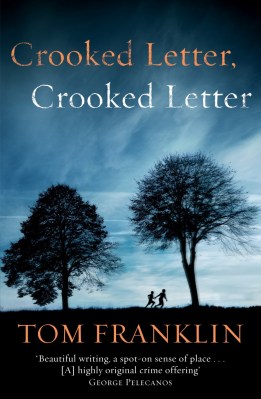
Tom Franklin, Crooked, Letter, Crooked Letter (London: Macmillan, 2011 [2010]). A compelling crime novel that explores the far-reaching legacy of an unsolved crime in America’s Deep South 4.5 stars
Opening line: The Rutherford girl had been missing for eight days when Larry Ott returned home and found a monster waiting in his house.
Crooked Letter, Crooked Letter is a complex, many-layered novel that explores the relationship between an impoverished black boy and awkward white boy in the 1970s, an unsolved crime and the cumulative effect of its poisonous legacy over twenty-five years, and the intricate workings of small-town prejudice.
When Cindy Walker disappears in 1982, suspicion falls on oddball teenager Larry Ott, the last person seen with her at a drive-in movie that fateful night. While nothing is ever proved, the 500 residents of Chabot in Mississippi draw their own conclusions, condemning Larry to a lonely life of almost total social exclusion, waiting for out-of-town customers at the family garage who seldom come. When college student Tina Rutherford goes missing twenty-five years later, negative assumptions are once again swiftly made, placing Larry’s life at risk. It’s up to Silas Jones, who escaped the rural black poverty of Chabot through baseball, but is now back as its sole law enforcement officer, to investigate the truth of what happened to Cindy and Tina. This process is one that will lead him to examine his own uneasy friendship with Larry during their childhood, and to confront the complexities of their unresolved past.
The novel is an extremely well-written and satisfying read, with chapters switching between the present-day investigation and the past, and alternating between Larry’s and Silas’s points of view. Both of these characters are skilfully drawn, as is the setting of Chabot and the steamy landscape of the Deep South (‘he smelled the hot after-rain and listened to the shrieking blue jays, alone at the edge of a wall of woods, miles from anywhere…’). Most impressive, however, is the dissection of the repurcussions that one set of events can have down the years, and the central question the novel poses of how far individuals and communities can make amends for past errors or moral failures.
Of the crime novels I’ve read recently, Crooked Letter forms part of a loose trilogy in my mind with Malla Nunn’s A Beautiful Place to Die (reviewed here) and Peter May’s The Blackhouse (not yet reviewed). Each has a wonderful sense of place (the Deep South, South Africa and the Isle of Lewis respectively) and successfully depicts small but socially complex communities. While Franklin and Nunn’s novels both explore tensions within racially-divided communities, Franklin and May’s novels can be viewed as coming-of-age stories, whose investigators are forced to re-examine pasts they had long packed away. Of the three novels, Crooked Letter is the one I enjoyed most fully: although the other two were fulfilling reads in a number of respects, they were slightly let down in my view by excessively melodramatic endings.
Further information about Tom Franklin (who was born in small town very much like Chabot) is available here. You can also read the first three chapters of the novel here.
Mrs. Peabody awards Crooked Letter, Crooked Letter a highly satisfying 4.5 stars.

 Mrs. Peabody Investigates