#22 Tom Franklin / Crooked Letter, Crooked Letter

Tom Franklin, Crooked, Letter, Crooked Letter (London: Macmillan, 2011 [2010]). A compelling crime novel that explores the far-reaching legacy of an unsolved crime in America’s Deep South 4.5 stars
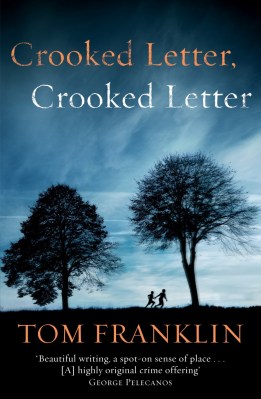
Opening line: The Rutherford girl had been missing for eight days when Larry Ott returned home and found a monster waiting in his house.

Crooked Letter, Crooked Letter is a complex, many-layered novel that explores the relationship between an impoverished black boy and awkward white boy in the 1970s, an unsolved crime and the cumulative effect of its poisonous legacy over twenty-five years, and the intricate workings of small-town prejudice.

When Cindy Walker disappears in 1982, suspicion falls on oddball teenager Larry Ott, the last person seen with her at a drive-in movie that fateful night. While nothing is ever proved, the 500 residents of Chabot in Mississippi draw their own conclusions, condemning Larry to a lonely life of almost total social exclusion, waiting for out-of-town customers at the family garage who seldom come. When college student Tina Rutherford goes missing twenty-five years later, negative assumptions are once again swiftly made, placing Larry’s life at risk. It’s up to Silas Jones, who escaped the rural black poverty of Chabot through baseball, but is now back as its sole law enforcement officer, to investigate the truth of what happened to Cindy and Tina. This process is one that will lead him to examine his own uneasy friendship with Larry during their childhood, and to confront the complexities of their unresolved past.

The novel is an extremely well-written and satisfying read, with chapters switching between the present-day investigation and the past, and alternating between Larry’s and Silas’s points of view. Both of these characters are skilfully drawn, as is the setting of Chabot and the steamy landscape of the Deep South (‘he smelled the hot after-rain and listened to the shrieking blue jays, alone at the edge of a wall of woods, miles from anywhere…’). Most impressive, however, is the dissection of the repurcussions that one set of events can have down the years, and the central question the novel poses of how far individuals and communities can make amends for past errors or moral failures.

Of the crime novels I’ve read recently, Crooked Letter forms part of a loose trilogy in my mind with Malla Nunn’s A Beautiful Place to Die (reviewed here) and Peter May’s The Blackhouse (not yet reviewed). Each has a wonderful sense of place (the Deep South, South Africa and the Isle of Lewis respectively) and successfully depicts small but socially complex communities. While Franklin and Nunn’s novels both explore tensions within racially-divided communities, Franklin and May’s novels can be viewed as coming-of-age stories, whose investigators are forced to re-examine pasts they had long packed away. Of the three novels, Crooked Letter is the one I enjoyed most fully: although the other two were fulfilling reads in a number of respects, they were slightly let down in my view by excessively melodramatic endings.

Further information about Tom Franklin (who was born in small town very much like Chabot) is available here. You can also read the first three chapters of the novel here.

Mrs. Peabody awards Crooked Letter, Crooked Letter a highly satisfying 4.5 stars.

Creative Commons License

.

The Bridge – Review of Episodes 1 and 2

At the centre of the 7,845 metre Oresund Bridge that links Denmark and Sweden, lying across the yellow line that marks the border between the two, the lifeless body of a woman is found. Although the victim at first appears to be Swedish, the national juristiction of the case turns out to be far from clear, leading a police officer from each country being assigned to the case. Swedish investigator Saga Noren (Sofia Helm) and her Danish counterpart Martin Rodhe (Kim Bodnia) both soon realise that they’ve been pulled into a difficult, bizarre and highly complex case.

Thus begins the acclaimed crime drama The Bridge/Bron/Broen, whose first episodes aired last night on BBC4 between 9.00 and 11.00pm.

Even from the title sequence, with its beautiful, nocturnal time-lapse photography and haunting theme (‘Hollow Talk’ by the Choir of Young Believers), it was clear that we were in for a treat. By the end of the first two episodes I was fully gripped, as the investigative narrative unfolded and two intriguing sub-plots took shape: a rich wife rushing her husband to hospital for a transplant operation, and a man helping a young woman escape an abusive husband, but with a murky past of his own.

In Saga Noren and Martin Rodhe we are given a classic investigative ‘odd couple’. Saga is a particularly interesting character, whose sometimes unconventional behaviour leads her colleagues to regard her as ‘a bit special’. She is a brilliant and knowledgeable investigator, who is ruthlessly logical and focused, and finds social niceties a baffling waste of time. As already discussed in the comments of an earlier post, it’s possible that she has a form of high-functioning autism. (In terms of other TV characters, she reminded me a bit of Star Trek‘s Seven of Nine!) Martin, by contrast, is more of an old school cop, who has a complicated private life and doesn’t always do things by the book, but who seems to take Saga’s behaviour (such as calling him in the early hours with a fresh lead) in his stride. The dynamic between the two looks promising.

- Hmm, not sure what I make of you.
- Feeling's mutual

Some other random observations at this point:

In contrast to The Killing, there are moments of genuine, albeit dark humour in The Bridge, which worked well for me. Watch out for Saga’s ‘romantic’ date (and make a note of how not to put off hunky Swedes the morning after).

The obligatory autopsy scene allows us to appreciate Saga’s intelligence and investigative focus (and was therefore justifiably included in my view). There are some quite graphic photos from the autopsy featured later on, but I’m hoping that’ll be it for now.

The series has an interesting 70s styling. Its palette of browns, oranges and beiges reminded me a little of the recent film adaptation of Tinker Tailor Soldier Spy, directed by the Swede Tomas Alfredson. One of the characters (flares, leather jacket, moustache) could have stepped straight out of Life On Mars.

I’m very much enjoying the transnational flavour of the series, which is evident in the Danish/Swedish credits, the characters’ dialogue, and of course the plot itself. And yes, they do all understand one another, but Martin has to repeat himself more s-l-o-w-l-y at one point so that the Swedes can follow him properly!

The murderer’s motives look complex and interesting: ‘if you had cared there would have been no victims’. It looks like the series will follow in the tradition of Swedish crime writing (Sjowall & Wahloo, Mankell) by foregrounding social issues. Mindful of spoilers, I shall say no more.

The Oresund Bridge looks remarkably like the Severn Bridge at times (Welsh-English remake please!).

Tonight’s episodes are both repeated and available on BBC iPlayer.

Below is a handy map with the Oresund Bridge to help with orientation: it joins Denmark and its capital city Copenhagen on the left and Sweden’s Malmo, the third largest city after Stockholm and Gothenburg, on the right.

Looking forward to next week’s episodes already!

BBC4 The Bridge – start date confirmed

FOR DETAILS ABOUT SERIES TWO SEE HERE.

With many thanks to Rhian for alerting me to the following:

The Swedish/Danish crime series The Bridge begins on Saturday 21 April at 9.00 pm. Two episodes will be aired that evening (totalling two hours). Further details are available via The Radio Times, which features Sofia Helin, one of the series’ stars, on its front cover this week.

A BBC4 press release describes the series thus: “The Bridge, a 10-part investigative crime drama, begins when the body of a woman is found in the middle of the Oresund Bridge between Sweden and Denmark. A bi-national team is put together to solve the crime and the killer, always one step ahead of the police, becomes the object of a dramatic manhunt.”

The stars of The Bridge, Sofia Helin and Kim Bodnia

Not only is The Bridge a Swedish/Danish co-production, it’s a bilingual one.

The original title (which appears on the cover of the DVD) is Bron/Broen, and dialogue is delivered in both languages, reflecting the operations of the bi-national investigative team. I’m not sure if this is a first, but I find the idea of a bilingual crime series quite fascinating (imagine, for example, a British/French series investigating a murder at the exact centre of the Channel Tunnel!). Do the Swedish and Danish investigators all understand/speak their opposite number’s language? Do they switch languages depending on the country they happen to be in? I won’t easily be able to tell, as the languages will only be fully comprehensible to me via subtitles, but perhaps someone can provide illumination!

I’ve heard many good things from those who’ve already watched the series and look forward to seeing it immensely.

Check out the wonderfully atmospheric title sequence with its time-lapse photography on YouTube. The title-track, ‘Hollow Talk’, is by the Danish group Choir of Young Believers.

Friedrich Dürrenmatt’s The Pledge (first review of Swiss crime!)

Friedrich Dürrenmatt, The Pledge (Das Verbrechen), tr. from the German by Joel Agee, Pushkin Press 2017 [1958].

 First line: Last March I had to give a lecture in Chur on the art of writing detective stories.

There are very few crime novels that I keep coming back to, but The Pledge is one of them. Written over half a century ago in 1958, it’s one of three crime novels by the renowned Swiss dramatist and writer Friedrich Dürrenmatt (the others are The Judge and his Hangman (1950) and Suspicion (1951)). The Pledge is my favourite of the three, for its fine writing and penetrating critique of the crime genre. Its tantalising subtitle is Requiem auf den Kriminalroman or ‘Requiem for the Crime Novel’.

The Pledge tells the story of Swiss police inspector Matthäi, who just is clearing his desk prior to a secondment in Jordan when a young girl’s murder is called in. After breaking the news to the girl’s parents, Matthäi is asked by the mother to promise ‘on his eternal salvation’ that he will find the murderer, and this, after a brief hesitation, he does: the pledge of the title. Thus begins a long investigation, which eventually tips over into a personal obsession that will threaten Matthäi’s sanity (making him one of the most  sympathetic investigative figures in the genre).

Matthäi’s tale is told to the figure of ‘the author’ by Dr. H, a former chief of police in Zurich, who was also once Matthäi’s boss. Dr. H is prompted to recount the story after attending the author’s talk on writing detective fiction, as a means of highlighting the ‘lies’ peddled by his work:

“What really bothers me about your novels is the storyline, the plot. There the lying just takes over, it’s shameless. You set up your stories logically, like a chess game: here’s the criminal, there’s the victim, here’s an accomplice, there’s a beneficiary. And all the detective needs to know is the rules: he replays the moves of the game, and checkmate, the criminal is caught and justice has triumphed. This fantasy drives me crazy. You can’t come to grips with reality by logic alone. Granted, we police are forced to proceed logically, scientifically; but there is so much interference, so many factors mess up our schemes that success very often amounts to no more than professional luck and pure chance working in our favour. […] But you fellows in the writing game don’t care about that. You don’t try to grapple with a reality that keeps eluding us, you just set up a manageable world. That world may be perfect, but it’s a lie.”

So it’s the disjunction between the controlled fictions produced by ‘the author’ and the frustrating ‘reality’ of Matthäi’s troubled investigation that’s the catalyst for Dr. H’s narrative – a wonderful ‘frame story’ that cheekily critiques the very genre the novel employs and implicitly wags a finger at all crime fiction fans for buying into its fantasy world.

As if all of this wasn’t clever enough, Dürrenmatt manages to have his cake and eat it too, by relating a story that thematises the impossibility of absolute closure and justice, but also provides the reader with a satisfying resolution in line with the expectations of the genre. Although of course, that could just be ‘the author’ meddling with the tale Dr. H told him…

The novel was adapted for film in 2001, directed by Sean Penn and with Jack Nicholson in the lead role.