Have yourself a merry little Christmas…

Mrs. P. hopes you have a very lovely Christmas and that Santa brings you all the crime novels your heart desires.

Have you been good?! I’m sure you have.

In that case, here’s a sublime version of ‘Have Yourself a Merry Little Christmas’, complete with Hammond organ, from She and Him. Enjoy.

#17 Sam Hawken / The Dead Women of Juárez

Sam Hawken, The Dead Women of Juárez (London: Serpent’s Tail, 2011). An outstanding crime novel set in the corrupt Mexican border city of Juárez, infamous for its high rate of ‘feminicidios’ (female homicides)  5 stars

 Opening sentence:  Roger Kahn wrote, ‘Boxing is smoky halls and kidneys battered until they bleed,” but in Mexico everything bled in the ring.

The Dead Women of Juárez is one of those crime novels that transcends genre and can be thought of, quite simply, as an excellent piece of writing. Set in the Mexican border city of Juárez, just across from El Paso, Texas, it draws on the legacy of American writers such as Hemingway to explore in succinct, precise, but highly evocative language the brutalising nature of life in Juárez, and the violence and corruption that pervade its politics and policing.

Ciudad Juárez is arguably the perfect place to set a crime novel, given its dubious real-life distinction of being the murder capital of the world. But Hawken chooses to focus on one specific group of the city’s murder victims, namely the 400 women killed there since 1993, and the estimated 3000 (that’s three thousand) women who have simply disappeared and are presumed dead – the victims of sexual attacks and ‘femicide’.

The novel explores the abject failure of the authorities to deal with the feminicidios, and the toll that the murders take on the women’s families, from the perspective of two highly damaged individuals: Kelly Courter, a washed-up American boxer reduced to the role of punchbag for talented younger fighters in the ring, and Raphael Sevilla, a narcotics investigator jaded from his many years on the police-force, who is hiding a serious drink problem. The link between the two is Paloma Esteban, Courter’s on-off girlfriend, the sister of a local drug dealer Sevilla is trying to nail, and a campaigner for the group Mujeres Sin Voces (Mothers without Voices), which seeks justicia (justice) for Juárez’s victims of femicide. When yet another woman goes missing, Courter and Sevilla find themselves drawn into an investigation that will radically change both of their lives.

As well as being a hard-hitting crime novel, and a scathing critique of power, corruption and misogyny, The Dead Women of Juárez offers readers an eye-opening depiction of contemporary Mexican society, whose impoverished majority endure punishing and poorly-paid working conditions in the maquiladoras – factories that turn out consumer goods for American companies. While only a stone’s throw away from America, the workers of Juárez may as well inhabit a different planet, given the disjunction between their lives and those of more affluent U.S. citizens living a few miles away. On another level, the novel also functions as a study of failed masculinity, through the symbolic figure of the boxer who undergoes a series of highly bruising rounds with life. The characterisation of Courter is superb, as is that of Sevilla, and the novel is worth reading for these two nuanced and very human portraits alone.

I especially like the way this book openly identifies itself as a campaigning crime novel (one of its key sources is Teresa Rodriguez’s journalistic study The Daughters of Juarez). In his afterword, Hawken states that his aim was to ‘shine a light on these femicides’ and the state’s failure to respond adequately to the epidemic of violence against women. Only a handful of cases have ever reached court, which is extraordinary given the scale of the murders and disappearances. (Imagine for a second how we would feel if the same were happening in the British city of Birmingham, which like Juárez has a population of around one million people…). An additional problem is that the murders have been overshadowed by the drug wars in the area, in spite of the work carried out by Amnesty International  and women’s groups such as Voces sin Echo (Voices without an Echo) and Las Mujeres de Negro (Women in Black). Hawken emphasises the importances of securing justice for the women before the law (providing an interesting contrast to the way that justice is depicted in the narrative), and his novel is a great example of how the crime genre can be harnessed to raise awareness of real crimes and miscarriages of justice.

The Dead Women of Juárez was shortlisted for the CWA New Blood Dagger 2011, which means that this highly accomplished piece of work is – remarkably – Sam Hawken’s debut novel. Beautifully written and with a tremendous sense of place, it stands head and shoulders above many others in its field. Along with Ernesto Mallo’s Needle in a Haystack and Jussi Adler-Olsen’s Mercy, it is one of my stand-out crime novels of the year.

Mrs Peabody awards The Dead Women of Juárez a superlative 5 stars.

Creative Commons License
.

Forbrydelsen / The Killing Series 2 Finale

First of all, I just have to say: I KNEW IT!!!

I got the murderer dramatically wrong at the end of Forbrydelsen I, so a brief moment of smugness at correctly identifying the perp is permitted!

Some general musings at the end of this excellent second series:                        (no spoilers in line with Mrs. P. policy)

  1. A few people had warned me that the second series wasn’t as good as the first, but I found it immensely enjoyable. The 10-episode format over five weeks inevitably made for a more intense viewing experience, but one that worked extremely well for me. Not least, it was easier to keep the whole of the plot in your head for the duration, and I felt that there were fewer loose ends than in series 1. 
  2. To put this another way, series 2 was a very different entity to the first series, whose 20 episodes explored one central murder and its wider effects at a much slower pace. But Forbrydelsen II worked well on its own more succinct terms.
  3. There were also plenty of similarities between the two series, not least that both featured a strong political storyline and focused on the twin themes of power and corruption. (If there’s a criticism to be made of series 2, it would be of this political strand – for reasons that I can’t go into without revealing major bits of plot…).   
  4. Both series have a pleasing circular narrative (they end where they began in a number of fascinating ways).
  5. Lund rocks! I loved the continuing exploration of her character and the tensions between her duties as a policewoman and her personal life (taken in a slightly different and exceedingly interesting direction this time round).

Roll on Series 3!

Forbrydelsen II's investigative team: Brix, Lund and Strange

If you wish to leave a comment, please don’t give away any details of the plot, to protect those viewers who have yet to see the series.

If you’d like to find out the identity of the murderer or if you wish to comment in more detail on the specifics of the plot, you can do so at Vicky Frost’s excellent blog at The Guardian.

Vikas Swarup’s Six Suspects (India)

Vikas Swarup, Six Suspects (London: Black Swan 2008). The crime novel as vehicle for a darkly humorous and highly critical portrait of modern India. 

 Opening sentence: Not all deaths are equal. There’s a caste system even in murder.

For the first time this blog travels to India, as part of a concerted effort to broaden its transnational criminal horizons.

Six Suspects is the second literary offering of Vikas Swarup, who hit the international jackpot when his highly-praised first novel, Q&A, was adapted for film as the phenomenally successful Slumdog Millionaire (eight Oscars and numerous other accolades). Not bad for a book that was written in a mere two months.

Six Suspects is a rather unusual crime novel. While drawing heavily on the conventions of classic detective fiction (there’s a murder, a drawing room of sorts, and the eponymous set of suspects), Swarup uses the genre primarily for satirical purposes, providing the reader with a darkly humorous and often scathing critique of modern India.

The suspects – a bureaucrat, a Bollywood actress, a thief, a politician, an American tourist and a tribesman from the Andaman Islands – are selected for the spectrum of perspectives they offer on contemporary Indian society, and allow Swarup to explore his key themes of political corruption, power and class in an uncompromising fashion (pretty daring given his day job as a member of the Indian civil service; currently Consul-General of India in Osaka-Kobe, Japan).

Much of the novel is taken up with tracing the life stories of the suspects and the motives that they might have had for killing Vivek ‘Vicky’ Rai, a disreputable thirty-two-year-old businessman and playboy, who also happens to be the son of the powerful Home Minister of Uttar Pradesh. In contrast, relatively little emphasis is placed upon the process of investigation: the role of detective is played in part by Arun Advani, a journalist renowned for exposing corruption and injustice, but he only features significantly at the beginning and the end of this chunky 557-page text.

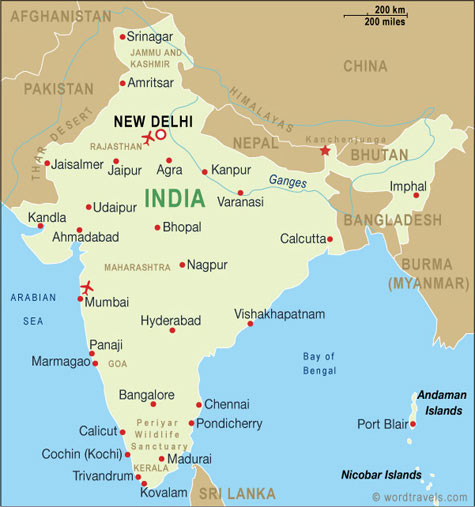
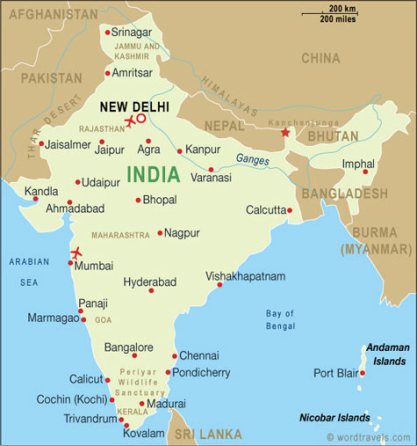
I found Six Suspects very enjoyable in a number of respects. As someone who has visited India in the past, the novel’s evocative descriptions of the sights and sounds of everyday life, and the huge disjunction between rich and poor rang very true. The novel also travels widely around India, beginning and ending in Delhi, but taking in other locations such as Srinagar, Jaisalmer, Varanasi, Kolkata and the Andaman Islands on the way (the latter are a remote and very beautiful group of islands in the Bay of Bengal that ‘belong’ politically to India, and which are home to ethnic tribes such as the Onges and Jarawa). The novel thus takes readers on a wide-ranging geographical and cultural journey which will be highly rewarding for those with an interest in India.
Another hugely enjoyable aspect of the novel is its biting satirical humour, and its witty nod to Salman Rushdie and magical realism (I particularly liked the possession of a grumpy, philandering ex-politician by the spirit of Mahatma Gandhi).

On the minus side, I felt the novel was a bit overlong and that its depiction of some characters and incidents was too exaggerated to be effective in the larger context of Swarup’s satire. As a result, the narrative felt rather uneven at times, and while I remained admiring of the author’s ambitious use of the crime genre to create a satirical portrait of India, I wasn’t sure that he’d completely succeeded in his aim when I closed the book for the final time.

I discovered Six Suspects at our city library, which has a superlative collection of crime fiction. If you’d like to read an extract from the novel, you can do so here on the author’s website.